>
Clupeiformes (Herrings) >
Alosidae (Shads and Sardines)
Etymology: Alosa: Latin, alausa = a fish cited by Ausonius and Latin, halec = pickle, dealing with the Greek word hals = salt; it is also the old Saxon name for shad = "alli" ; 1591 (Ref. 45335).
Environnement : milieu / zone climatique / profondeur / gamme de distribution
Écologie
; eau douce pélagique. Subtropical; 41°N - 40°N, 23°E - 24°E
Europe: Lakes Koronia (extirpated) and Volvi, Greece (ref. 59043).
Longueur à la première maturité / Taille / Poids / Âge
Maturité: Lm 12.4, range 11 - 14 cm
Max length : 35.1 cm FL mâle / non sexé; (Ref. 10545); poids max. publié: 600.00 g (Ref. 10545); âge max. reporté: 10 années (Ref. 10545)
Description synthétique
Clés d'identification | Morphologie | Morphométrie
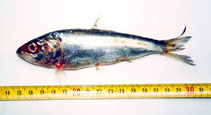
Épines dorsales (Total) : 3 - 4; Rayons mous dorsaux (Total) : 12 - 14; Épines anales: 3 - 4; Rayons mous anaux: 16 - 21. This species is distinguished from its congeners entering the freshwater in Mediterranean basin by the following characters: gill rakers 106-128; teeth on palatine and vomer well-developed, especially in juveniles (Ref. 59043).
Body shape (shape guide): fusiform / normal.
Landlocked, lacustrine, pelagic, in upper water layers during summer and descending to deeper layers in winter. It spawns at 1-2 years, near shores above gravel or coarse sand, with most individuals spawning more than one season. Spawning starts when temperature reach about 19-20°C, in July to August (Ref. 59043). Adults form schools in the epilimnion during summer and tend to congregate in shallow waters near shores. They feed on plankton (cladocerans and copepods) and small fishes (Ref. 10545, 59043). It is threatened by water abstraction and pollution (Ref. 26100).
Cycle de vie et comportement reproducteur
Maturité | Reproduction | Frai | Œufs | Fécondité | Larves
Deposits eggs near the shore where the sediment consists of gravel or coarse sand (Ref. 10545). Most individuals spawn in more than one season (Ref. 59043).
Economidis, P.S. and A.I. Sinis, 1991. Alosa macedonica (Vinciguerra 1921). p. 297-308. In H. Hoestlandt (ed.) The freshwater fishes of Europe. Vol. 2. Clupeidae, Anguillidae. AULA-Verlag Wiesbaden. (Ref. 10545)
Statut dans la liste rouge de l'IUCN (Ref. 130435: Version 2025-2 (Global))
Menace pour l'homme
Harmless
Utilisations par l'homme
Pêcheries: intérêt commercial mineur
Outils
Articles particuliers
Télécharger en XML
Sources Internet
Estimations basées sur des modèles
Indice de diversité phylogénétique (Réf.
82804): PD
50 = 0.5000 [Uniqueness, from 0.5 = low to 2.0 = high].
Bayesian length-weight: a=0.00537 (0.00308 - 0.00936), b=2.99 (2.84 - 3.14), in cm total length, based on LWR estimates for this species & Genus-body shape (Ref.
93245).
Niveau trophique (Réf.
69278): 3.7 ±0.64 se; based on food items.
Résilience (Réf.
120179): Milieu, temps minimum de doublement de population : 1,4 à 4,4 années (tm=1; tmax=10; K=0.403).
Vulnérabilité de la pêche (Ref.
59153): Low to moderate vulnerability (29 of 100).
🛈