Taxonomic Remarks
Species complex include Gymnura lessae and
Gymnura sereti; distribution of and both species were included for Gymnura micrura. Distribution will be corrected.
Lingkungan: lingkungan / zona iklim / kisaran kedalaman / jangkauan distribusi
Ekologi
laut; payau dasar (demersal); kisaran kedalaman ? - 55 m (Ref. 27549). Deep-water
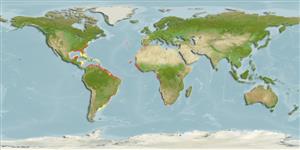
Southwestern Atlantic: Venezuela, including Trinidad and Tobago, to Brazil (Rio de Janeiro).
Panjang pada saat jatuh tempo pertama / Ukuran / Berat / umur
Kematangan: Lm 35.0, range 34 - 50 cm
Deprecated: number_format(): Passing null to parameter #1 ($num) of type float is deprecated in /var/www/html/includes/common.lib.php on line 1833
Max length : 137 cm WD jantan/; (Ref. 4439); common length : 90.0 cm WD jantan/; (Ref. 5217); Berat maksimum terpublikasi: 0.00 g
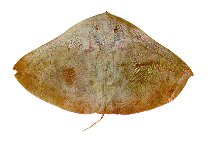
Broad, diamond-shaped ray with a very short tail lacking a dorsal spine (Ref. 26938). Snout protruding. Front edges of disk concave. Tail with low dorsal and ventral finfolds and 3 - 4 dark crossbars (Ref. 7251). Upper surface gray, brown, light green or purple with round spots. Lower surface white (Ref. 6902).
Body shape (shape guide): other.
Prefers neritic waters of the continental shelf and
usually found on soft bottoms. May enter brackish
estuaries or hyper-saline lagoons (Ref. 5217). Feeds on
fish and shrimps (Ref. 28587); other crustaceans and clams
(Ref. 27549). Ovoviviparous (Ref. 50449). Generally
marketed salted (Ref. 5217).
Exhibit ovoviparity (aplacental viviparity), with embryos feeding initially on yolk, then receiving additional nourishment from the mother by indirect absorption of uterine fluid enriched with mucus, fat or protein through specialised structures (Ref. 50449). Distinct pairing with embrace (Ref. 205).
Yokota, L. and M.R. de Carvalho, 2017. Taxonomic and morphological revision of butterfly rays of Gymnura micrura (Bloch & Schneider, 1801) species complex, with the description of two new species (Myliobatiformes: Gymnuridae). Zootaxa 4332(1):1-74. (Ref. 116399)
Status IUCN Red List (Ref. 130435: Version 2025-2 (Global))
ancaman kepada manusia
Harmless
penggunaan manusia
Perikanan: nilai komersial kecil
Alat, peralatan
laporan khas
muat turun XML
Sumber internet
Estimasi berdasarkan model
Suhu yang disukai (Acuan
123201): 21.8 - 27.9, mean 25 °C (based on 544 cells).
Indeks keanekaragaman filogenetik (Acuan
82804): PD
50 = 0.5000 [Uniqueness, from 0.5 = low to 2.0 = high].
Bayesian length-weight: a=0.00537 (0.00331 - 0.00870), b=3.09 (2.94 - 3.24), in cm total length, based on LWR estimates for this species & (Sub)family-body (Ref.
93245).
Tingkat Trofik (Acuan
69278): 3.6 ±0.53 se; based on food items.
Daya lenting (Acuan
120179): sangat rendah, Waktu penggandaan populasi minimum lebih dari 14 tahun (Fec=3).
Kerentanan Penangkapan Ikan (Ref.
59153): Moderate vulnerability (43 of 100).
🛈
Nutrisi (Ref.
124155): Calcium = 7.1 [1.0, 38.4] mg/100g; Iron = 0.314 [0.067, 0.935] mg/100g; Protein = 21.9 [18.4, 24.9] %; Omega3 = 0.234 [0.058, 0.711] g/100g; Selenium = 8.65 [2.29, 27.32] μg/100g; VitaminA = 6.06 [1.19, 29.85] μg/100g; Zinc = 0.395 [0.196, 0.738] mg/100g (wet weight);