Klassifizierung / Names
Namen | Synonyme | Catalog of Fishes(Gattung, Arten) | ITIS | CoL | WoRMS | Cloffa
>
Cypriniformes (Carps) >
Cyprinidae (Minnows or carps) > Barbinae
Etymology: Barbus: Latin, barbus = barbel (Ref. 45335).
Eponymy: Sir Charles Alfred Payton (1843–1926) was a British adventurer, writer, fisherman and diplomat who was British Consul to Morocco, where this barb is found. [...] (Ref. 128868), visit book page.
More on author: Bonaparte.
Umwelt: Milieu / Klimazone / Tiefenbereich / Verbreitungsgebiet
Ökologie
; süßwasser benthopelagisch. Temperate; 18°C - 28°C (Ref. 12468)
Europe: Adriatic basin, between Marecchia and Brenta drainages (Italy, Switzerland). Introduced in Arno and Ombrone drainages in Italy. Previously misidentified as Barbus meridionalis. Records of Barbus caninus from Soca refer to Barbus balcanicus.
Größe / Gewicht / Alter
Geschlechtsreife: Lm ? range ? - ? cm
Max length : 25.0 cm SL Männchen/unbestimmt; (Ref. 59043); max. veröff. Alter: 5 Jahre (Ref. 59043)
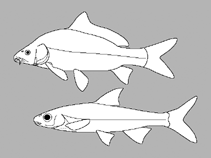
Rückenflossenweichstrahlen (insgesamt) : 7 - 8. Diagnosed from its congeners in Apennine Peninsula by having the following characters: 36-47 + 2-3 scales on lateral line; 22-24 scale rows around caudal peduncle; back, sides and fins speckled with large, irregular black spots and blotches; peritoneum black; last simple dorsal ray flexible, not serrated posteriorly; lower lip produced posteriorly into a median lobe (Ref. 59043). Fins are thick and fleshy; caudal fin lobes are rounded (Ref. 31730).
Body shape (shape guide): elongated.
Tends to inhabit strong currents around or under stones (Ref. 31730). Occurs in streams with swift water in hilly, sub-alpine areas. Preys on benthic invertebrates. Spawns in areas with fast-flowing water on gravel bottom. Still commonly found in suitable habitats, but number of spawning grounds has decline sharply (Ref. 59043).
Bianco, P.G., 1998. Diversity of Barbinae fishes in southern Europe with description of a new genus and a new species (Cyprinidae). Ital. J. Zool. 65:125-136. (Ref. 31730)
IUCN Rote Liste Status (Ref. 130435: Version 2025-2 (Global))
Bedrohung für Menschen
Harmless
Nutzung durch Menschen
Tools
Zusatzinformationen
Download XML
Internet Quellen
Schätzungen auf der Grundlage von Modellen
Phylogenetischer Diversitätsindex (Ref.
82804): PD
50 = 0.5000 [Uniqueness, from 0.5 = low to 2.0 = high].
Bayesian length-weight: a=0.00794 (0.00367 - 0.01719), b=3.05 (2.88 - 3.22), in cm total length, based on LWR estimates for this Genus-body shape (Ref.
93245).
Trophische Ebene (Ref.
69278): 3.1 ±0.4 se; based on size and trophs of closest relatives
Generation time: 1.8 ( na - na) years. Estimated as median ln(3)/K based on 1
growth studies.
Widerstandsfähigkeit (Ref.
120179): hoch, Verdopplung der Population dauert weniger als 15 Monate. (Preliminary K or Fecundity.).
Anfälligkeit der Fischerei (Ref.
59153): Low vulnerability (21 of 100).
🛈