>
Esociformes (Pikes and mudminnows) >
Esocidae (Pikes)
Etymology: Esox: From Greek, isox and also related with the Celtic root, eog, ehawc = salmon (Ref. 45335); lucius: lucius which is supposedly the latin name for this species (Ref. 1998).
More on author: Linnaeus.
Ambiente: milieu / zona climatica / distribuzione batimetrica / gamma di distribuzione
Ecologia
; acqua dolce; salmastro pelagico; potamodromo (Ref. 126106); distribuzione batimetrica 0 - 30 m (Ref. 1998), usually 1 - 5 m (Ref. 1998). Subtropical; 10°C - 28°C (Ref. 12741); 72°N - 37°N, 11°W - 55°W (Ref. 121102)
Circumpolar in fresh water. North America: Atlantic, Arctic, Pacific, Great Lakes, and Mississippi River basins from Labrador to Alaska and south to Pennsylvania and Nebraska, USA (Ref. 86798). Eurasia: Caspian, Black, Baltic, White, Barents, Arctic, North and Aral Seas and Atlantic basins, southwest to Adour drainage; Mediterranean basin in Rhône drainage and northern Italy. Widely distributed in central Asia and Siberia easward to Anadyr drainage (Bering Sea basin). Historically absent from Iberian Peninsula, Mediterranean France, central Italy, southern and western Greece, eastern Adriatic basin, Iceland, western Norway and northern Scotland. Widely introduced and translocated throughout Europe (Ref. 59043). Several countries report adverse ecological impact after introduction (Ref. 1739).
Lunghezza alla prima maturità / Dimensione / Peso / Età
Maturità: Lm 39.9, range 25 - 63 cm
Max length : 137 cm FL maschio/sesso non determinato; (Ref. 40637); 150.0 cm TL (female); common length : 40.0 cm TL maschio/sesso non determinato; (Ref. 556); common length :55 cm TL (female); peso massimo pubblicato: 28.4 kg (Ref. 40637); peso massimo pubblicato: 28.4 kg; Età massima riportata: 30 anni (Ref. 556)
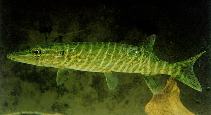
Raggi dorsali molli (totale) : 17 - 25; Raggi anali molli: 10 - 22; Vertebre: 57 - 65. Diagnosed from all other freshwater fishes in Europe by the combination of the following characters: long snout; large mouth; dorsal fin origin slightly in front of anal origin; and lateral line with 105-148 scales (Ref. 59043). Distinguished by its long, flat, 'duck-bill' snout; its large mouth with many large, sharp teeth; and the rearward position of its dorsal and anal fins (Ref. 27547). Gill rakers present only as patches of sharp teeth on gill arches; lateral line notched posteriorly (Ref. 27547). Dorsal located far to the rear; anal located under and arising a little behind dorsal; pectorals low on body, base under opercle; pelvic fins low on body; paired fins rounded, paddle-shaped (Ref. 27547). Caudal fin with 19 rays (Ref. 2196).
Body shape (shape guide): elongated.
Adults occur in clear vegetated lakes, quiet pools and backwaters of creeks and small to large rivers (Ref. 5723, 86798). Usually solitary and highly territorial. They enter brackish water in the Baltic. Adults feed mainly on fishes, but at times feed heavily on frogs and crayfish (Ref. 27547). Cannibalism is common. In arctic lakes, it is sometimes the only species present in a given water body. In such cases, juveniles feed on invertebrates and terrestrial vertebrates; large individuals are mainly cannibals (Ref. 59043). Cannibalistic as juveniles (Ref. 30578). Feces of pike are avoided by other fish because they contain alarm pheromones. Individuals deposit feces at specific locations, distant from its foraging area (Ref. 59043). Eggs and young are preyed upon by fishes, aquatic insect larvae, birds, and aquatic mammals (Ref. 1998). They do not generally undertake long migrations, but a few may move considerable distances (Ref. 27547). Oviparous (Ref. 205). This fish can be heavily infested with parasites, including the broad tapeworm which, if not killed by thorough cooking, can infect human; is used as an intermediate host by a cestode parasite which results to large losses in usable catches of lake whitefish (Coregonus clupeaformis) in some areas; also suffers from a trematode which causes unsightly cysts on the skin (Ref. 9988). Excellent food fish; utilized fresh and frozen; eaten pan-fried, broiled, and baked (Ref. 9988). Valuable game fish (Ref. 5723). In spite of numerous attempts to culture this species, it was never entirely domesticated and does not accept artificial food (Ref. 30578). Locally impacted by habitat alterations (Ref. 59043).
Spawners move inshore or upstream to the marsh areas to spawn (Ref. 27547). Generally, spawning occurs during the day. The sexes pair and a larger female is usually attended by one or two smaller males. They swim through and over the vegetation in water usually less than 17.8 cm, releasing eggs and sperm simultaneously at irregular intervals (Ref. 1998). Eggs are deposited in flooded areas and on submerged vegetation over a period of 2-5 days (Ref. 59043). Only 5 to 60 eggs ae released at a time (Ref. 27547). This act is repeated every few minutes for up to several hours, after which the fish rest for some time before resuming. During the resting period, both male and female may take new mates, or they may continue together for several days until all eggs are extruded. Spawned-out adults may stay on the spawning grounds for as long as 14 weeks, but most leave within 6 (Ref. 27547).
Crossman, E.J., 1996. Taxonomy and distribution. p. 1-11. In J.F. Craig (ed.) Pike biology and exploration. Chapman and Hall, London. 298 p. (Ref. 26373)
Stato della Lista Rossa IUCN (Ref. 130435: Version 2025-2 (Global))
Minaccia per l'uomo
Potential pest
Usi umani
Pesca: elevato interesse commerciale; Acquacoltura: commerciale; Pesce da pesca sportiva: si; Acquario: Acquari pubblici
Strumenti
Rapporti speciali
Scarica XML
Fonti Internet
Stime basate su modelli
Indice di diversità filogenetica (Fonte Biblio.
82804): PD
50 = 0.5157 [Uniqueness, from 0.5 = low to 2.0 = high].
Bayesian length-weight: a=0.00447 (0.00396 - 0.00503), b=3.08 (3.05 - 3.11), in cm total length, based on LWR estimates for this species (Ref.
93245).
Livello trofico (Fonte Biblio.
69278): 4.1 ±0.4 se; based on diet studies.
Generation time: 7.2 (5.7 - 8.4) years. Estimated as median ln(3)/K based on 35
growth studies.
Resilienza (Fonte Biblio.
120179): Basso, tempo minimo di raddoppiamento della popolazione 4.5 - 14 anni (K=0.07-0.3; tm=2-3; tmax=30; Fec=2,000-600,000).
Vulnerabilità della pesca (Ref.
59153): High to very high vulnerability (74 of 100).
🛈
Nutrienti (Ref.
124155): Calcium = 12.5 [8.3, 20.5] mg/100g; Iron = 0.154 [0.098, 0.289] mg/100g; Protein = 18.1 [16.4, 19.8] %; Omega3 = 0.235 [0.132, 0.413] g/100g; Selenium = 37.3 [13.8, 104.5] μg/100g; VitaminA = 13.3 [4.9, 37.0] μg/100g; Zinc = 0.749 [0.565, 1.048] mg/100g (wet weight); based on
nutrient studies.