Elasmobranchii (Haie und Rochen) (sharks and rays) >
Myliobatiformes (Stingrays) >
Myliobatidae (Eagle and manta rays)
Etymology: Myliobatis: Greek, mylo = mill + Greek, + Greek, batis,-idos = a ray (Raja sp.) (Ref. 45335).
More on author: Gill.
Umwelt: Milieu / Klimazone / Tiefenbereich / Verbreitungsgebiet
Ökologie
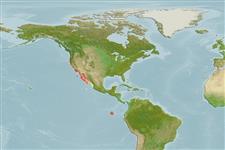
seewasser demersal; tiefenbereich 0 - 108 m (Ref. 96339). Subtropical; 43°N - 5°S, 126°W - 85°W (Ref. 55258)
Eastern Pacific: Oregon, USA to Gulf of California (Ref. 2850) and the Galapagos Islands (Ref. 28023).
Größe / Gewicht / Alter
Geschlechtsreife: Lm ? range ? - ? cm
Max length : 180 cm WD Männchen/unbestimmt; (Ref. 2850); common length : 100.0 cm WD Männchen/unbestimmt; (Ref. 9257); max. veröff. Gewicht: 82.1 kg (Ref. 40637)
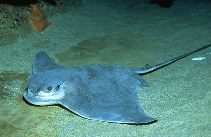
Commonly found in sandy and muddy bays and sloughs, also on rocky bottom and in kelp beds (Ref. 2850). Sometimes buries itself in sand (Ref. 2850). Found singly or in schools (Ref. 12951). Feeds on bivalves, snails, polychaetes, shrimps, and crabs (Ref. 9257). Ovoviviparous (Ref. 50449). Venomous spine on tail. Not fished commercially, but shows up as by-catch species (Ref. 9257).
Exhibit ovoviparity (aplacental viviparity), with embryos feeding initially on yolk, then receiving additional nourishment from the mother by indirect absorption of uterine fluid enriched with mucus, fat or protein through specialised structures (Ref. 50449).
McEachran, J.D. and G. Notarbartolo di Sciara, 1995. Myliobatidae. Aguilas marinas. p. 765-768. In W. Fischer, F. Krupp, W. Schneider, C. Sommer, K.E. Carpenter and V. Niem (eds.) Guia FAO para Identification de Especies para los Fines de la Pesca. Pacifico Centro-Oriental. 3 Vols. FAO, Rome. (Ref. 9257)
IUCN Rote Liste Status (Ref. 130435: Version 2025-2 (Global))
Nutzung durch Menschen
Fischereien: kommerziell; Sportfisch: ja; Aquarium: Öffentliche Aquarien
Tools
Zusatzinformationen
Download XML
Internet Quellen
Schätzungen auf der Grundlage von Modellen
Bevorzugte Temperatur (Ref.
123201): 12.4 - 23, mean 20.6 °C (based on 34 cells).
Phylogenetischer Diversitätsindex (Ref.
82804): PD
50 = 0.5002 [Uniqueness, from 0.5 = low to 2.0 = high].
Bayesian length-weight: a=0.00389 (0.00124 - 0.01219), b=3.08 (2.83 - 3.33), in cm total length, based on LWR estimates for this (Sub)family-body shape (Ref.
93245).
Trophische Ebene (Ref.
69278): 3.2 ±0.1 se; based on diet studies.
Widerstandsfähigkeit (Ref.
120179): niedrig, Verdopplung der Population dauert 4,5 - 14 Jahre. (tm=3; tmax=23; k=0.09-0.22).
Anfälligkeit der Fischerei (Ref.
59153): Very high vulnerability (75 of 100).
🛈
Nährstoffe (Ref.
124155): Calcium = 8.59 [1.10, 170.56] mg/100g; Iron = 0.647 [0.059, 7.948] mg/100g; Protein = 20.5 [15.2, 25.6] %; Omega3 = 0.159 [0.050, 0.437] g/100g; Selenium = 28.9 [5.9, 146.1] μg/100g; VitaminA = 3.22 [0.27, 34.64] μg/100g; Zinc = 0.476 [0.031, 5.520] mg/100g (wet weight);