>
Petromyzontiformes (Lampreys) >
Petromyzontidae (Northern lampreys) > Lampetrinae
Etymology: Caspiomyzon: Caspio, from the Caspian Sea basin, where C. wagneri is endemic; myzon (Gr.), to suck (borrowed from Petromyzon), referring to their suctorial behavior (See ETYFish); hellenicus: -icus, (Gr.) belonging to: Hellas (Gr.), Greece, referring to only country where it occurs (See ETYFish).
Taxonomic Remarks
Renaud and Economidis (2010) found that Eudontomyzon hellenicus is restricted to the Strymon River Basin, Aegean Sea Basin and that the Eudontomyzon species found in the Loúros River Basin, Ionian Sea Basin, is a different and new species, E. graecus (Ref. 89241). Both are in genus Caspiomyzon (Lang et al., 2009: Ref. 89370). Common name from Ref. 89241 replacing Greek brook lamprey.
Lingkungan: lingkungan / zona iklim / kisaran kedalaman / jangkauan distribusi
Ekologi
; air tawar dasar (demersal); potamodromous; kisaran kedalaman 0 - 1 m (Ref. 12282). Temperate; 42°N - 40°N, 23°E - 25°E (Ref. 59043)
Europe: Endemic to Greece. Known from three creeks in the Struma drainage.
Ukuran / Berat / umur
Kematangan: Lm ? range ? - ? cm
Max length : 18.9 cm TL jantan/; (Ref. 89241); Berat maksimum terpublikasi: 7.40 g (Ref. 12282)
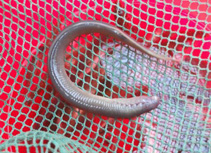
Duri punggung (Keseluruhan (total)) : 0; duri punggung lunak (Keseluruhan (total)) : 0; Duri dubur: 0; Sirip dubur lunak: 0. Adults: 9.55-15.85 cm TL. Body proportions, as percentage of TL (based on 66 specimens measuring 9.55-15.85 cm TL): prebranchial length, 8.4-13.1; branchial length, 9.5-12.4; trunk length, 46.4-54.7; tail length, 26.2-33.0; cloacal slit length, 0.6-2.0; eye length, 1.3-2.1; disc length, 2.9-7.3; prenostril length, 3.6-7.3; snout length, 4.4-8.9; postocular length, 2.3-3.8. The intestinal diameter, <0.05- 0.10 cm. The urogenital papilla length, as a percentage of branchial length, in eight spawning males measuring 9.6-13.3 cm TL, 3.3-9.1. Trunk myomeres, 53-63. Dentition: All labial teeth are pavement-like; supraoral lamina, 2 teeth, usually unicuspid, but one or both may be bicuspid; infraoral lamina, 7-11 teeth; typically 3 endolateral teeth on each side, but 4 teeth also occur (6 cases out of 96); endolateral formula, typically 2-2-2, but variant formulae occur in 25% of cases and each of the teeth can be either uni-, bi-, or tricuspid; 3-4 rows of anterials; first row of anterials, 4-8 teeth; 2-6 rows of exolaterals on each side; 1-4 rows of posterials; first row of posterials, 10-15 teeth; transverse lingual lamina with a greatly enlarged median tooth but no lateral teeth; longitudinal lingual laminae without teeth. Additonally, 9 of 66 adults possessed 1-2 accessory unicuspid teeth inside the ring formed by the supraoral and infraoral laminae and the endolateral teeth. Velar tentacles, 2-5. Body coloration (preserved) in mature adults is gray on the upper surface and flanks and light brown on the lower surface. Lateral line neuromasts unpigmented. Caudal fin pigmentation, + (2% of specimens), ++ (19%) or +++ (79%). Caudal fin shape, rounded (Ref.89241). Gray to black color of the caudal fins (Ref. 59043).
Body shape (shape guide): eel-like.
A short-lived, freshwater lamprey which lives in shallow, clear, fairly fast-flowing brooks with gravelly substrate, some rocks and aquatic plants (Ref. 26100). Adults are found at depths of 25-75 cm, in mud, especially among the roots of aquatic vegetation (Ref. 89241). They are filter feeders on microorganisms, including green algae (Ref. 26100). Adults are nonparasitic and believed to live for only 3-4 months. Spawning takes place in December up to May. Ammocoetes larvae live in detritus-rich sands and clay sediments (Ref. 59043). Metamorphosis takes place in December (Ref. 26100); between October and January in the Strymon and Loúros River Basins, Greece (Ref. 89241). Pollution and water obstruction are considered threats to the population (Ref. 26100).
Renaud, C.B., 1986. Eudontomyzon hellenicus Vladykov, Renaud, Kott, and Economidis, 1982. p. 186-195. In J. Holcík (ed.) The freshwater fishes of Europe. Petromyzontiformes. (Ref. 12282)
Status IUCN Red List (Ref. 130435: Version 2025-2 (Global))
ancaman kepada manusia
Harmless
penggunaan manusia
Perikanan: tidak ada kepentingan
Alat, peralatan
laporan khas
muat turun XML
Sumber internet
Estimasi berdasarkan model
Indeks keanekaragaman filogenetik (Acuan
82804): PD
50 = 0.6250 [Uniqueness, from 0.5 = low to 2.0 = high].
Bayesian length-weight: a=0.00132 (0.00060 - 0.00290), b=2.99 (2.80 - 3.18), in cm total length, based on LWR estimates for this (Sub)family-body shape (Ref.
93245).
Tingkat Trofik (Acuan
69278): 3.5 ±0.37 se; based on food items.
Daya lenting (Acuan
120179): Rendah, Waktu penggandaan populasi minimum 4.5 - 14 tahun (tmax=tm).
Kerentanan Penangkapan Ikan (Ref.
59153): Low vulnerability (10 of 100).
🛈