>
Cypriniformes (Carps) >
Cyprinidae (Minnows or carps) > Barbinae
Etymology: Barbus: Latin, barbus = barbel (Ref. 45335).
Eponymy: Sir Charles Alfred Payton (1843–1926) was a British adventurer, writer, fisherman and diplomat who was British Consul to Morocco, where this barb is found. [...] (Ref. 128868), visit book page.
More on author: Valenciennes.
Environnement : milieu / zone climatique / profondeur / gamme de distribution
Écologie
; eau douce benthopélagique. Temperate
Europe: endemic to the western Greece from Kalamas to Pamissos drainages. Introduced and established in the Isonzo River, northeastern Italy (Ref. 45688).
Taille / Poids / Âge
Maturité: Lm ? range ? - ? cm
Max length : 19.0 cm SL mâle / non sexé; (Ref. 59043)
Description synthétique
Clés d'identification | Morphologie | Morphométrie
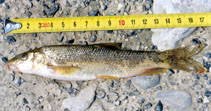
Rayons mous dorsaux (Total) : 7 - 9. Diagnosed from other species of Barbus and Luciobarbus in Balkan Peninsula by having the following characters: last simple dorsal ray not stronger than branched rays, not serrated posteriorly; 47-53 + 2-3 scales on lateral line; 5-7 scale rows between lateral and pelvic base; small black spots (plain in some populations from Peloponnese) on head and body; often faint dark stripes or faint rows of dark spots along scale rows; lower lip with a median swollen pad (Ref. 59043).
Body shape (shape guide): fusiform / normal.
Occurs in lakes and in water bodies on low-lying plains, with little current (Ref. 26100). Found in lower and upper parts of streams with stone bottom and current. Feeds on aquatic invertebrates (Ref. 59043). Threatened by water abstraction (Ref. 26100). Attains a maximum size of about 19 cm SL (Ref. 59043).
Cycle de vie et comportement reproducteur
Maturité | Reproduction | Frai | Œufs | Fécondité | Larves
Males and females splash during spawning (peaks in evening, at sunset). Individual females actively dig holes with anal, into which eggs are released (Ref. 59043). Fractional spawner (Ref. 59043).
Kottelat, M. and J. Freyhof, 2007. Handbook of European freshwater fishes. Publications Kottelat, Cornol and Freyhof, Berlin. 646 pp. (Ref. 59043)
Statut dans la liste rouge de l'IUCN (Ref. 130435: Version 2025-2 (Global))
Menace pour l'homme
Harmless
Utilisations par l'homme
Pêcheries: commercial; pêche sportive: oui
Outils
Articles particuliers
Télécharger en XML
Sources Internet
Estimations basées sur des modèles
Indice de diversité phylogénétique (Réf.
82804): PD
50 = 0.5000 [Uniqueness, from 0.5 = low to 2.0 = high].
Bayesian length-weight: a=0.00977 (0.00428 - 0.02232), b=2.98 (2.81 - 3.15), in cm total length, based on LWR estimates for this Genus-body shape (Ref.
93245).
Niveau trophique (Réf.
69278): 3.1 ±0.4 se; based on size and trophs of closest relatives
Résilience (Réf.
120179): Milieu, temps minimum de doublement de population : 1,4 à 4,4 années (Preliminary K or Fecundity.).
Vulnérabilité de la pêche (Ref.
59153): Low vulnerability (13 of 100).
🛈