Klassifizierung / Names
Namen | Synonyme | Catalog of Fishes(Gattung, Arten) | ITIS | CoL | WoRMS | Cloffa
>
Anabantiformes (Gouramies, snakeheads) >
Osphronemidae (Gouramies) > Macropodusinae
Etymology: Betta: Malay/Javanese origin. Bleeker (1850, 1858) indicates Ikan Wadder Bettah as the local name of Betta trifasciata Bleeker, 1849 (now Betta picta, Valenciennes, 1846) in the Ambarawa Javanese dialect. Ikan Wader is a common Javanese name for smaller freshwater fishes, especially cyprinids (already used in Old Javanese). See Blust, R. & Trussel, S. Austronesian Comparative Dictionary. Web Edition (https://www.trussel2.com/acd/).
Eponymy: Datuk (title) Chin Phui-Kong (d: 1923–fl. [...] (Ref. 128868), visit book page.
Umwelt: Milieu / Klimazone / Tiefenbereich / Verbreitungsgebiet
Ökologie
; süßwasser benthopelagisch; tiefenbereich 1 - ? m (Ref. 12293). Tropical
Asia: Sabah, Borneo, East Malaysia.
Größe / Gewicht / Alter
Geschlechtsreife: Lm ? range ? - ? cm
Max length : 5.1 cm SL Männchen/unbestimmt; (Ref. 12293); 5.6 cm SL (female)
Kurzbeschreibung
Bestimmungsschlüssel | Morphologie | Morphometrie
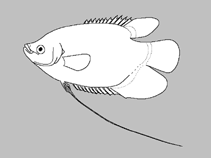
Rückenflossenstacheln (insgesamt) : 1; Rückenflossenweichstrahlen (insgesamt) : 7 - 9; Afterflossenstacheln: 2; Afterflossenweichstrahlen: 24 - 28; Wirbelzahl: 29 - 31. Can be differentiated from other members of the Betta akarensis group by possessing the following combination of characters: opercle with interrupted second postorbital stripe; eye color yellow when alive; anal-fin rays 26-30 (mode 28); subdorsal scales 5 1/2-7 (mode 6); lateral scales 30-31 9mode 31); predorsal scales 22-24 (mode 23); postdorsal scales 9-11 (mode 10); preanal length 42.6-45.7% SL; head length 31.4-33.3% SL; length of anal-fin base 54.8-58.5% SL (Ref. 56613).
Body shape (shape guide): fusiform / normal.
Facultative air-breathing (Ref. 126274); Found in shallow (less than 0.5 m depth) peat swamps with substrate consisting mainly of detritus, leaves and peat (Ref. 12293). An oral brooder (Ref. 56613).
Lebenszyklus und Paarungsverhalten
Geschlechtsreife | Fortpflanzung | Ablaichen | Eier | Fruchtbarkeit | Larven
Assumed to be the same as in Betta picta, i.e., the male is carying the aggs in his mouth for about 10 days.
Ng, P.K.L., 1993. On a new species of Betta (Teleostei: Belontiidae) from peat swamps in Sabah, East Malaysia, Borneo. Ichthyol. Explor. Freshwat. 4(4):289-294. (Ref. 12293)
IUCN Rote Liste Status (Ref. 130435: Version 2025-2 (Global))
Bedrohung für Menschen
Harmless
Nutzung durch Menschen
Tools
Zusatzinformationen
Download XML
Internet Quellen
Schätzungen auf der Grundlage von Modellen
Phylogenetischer Diversitätsindex (Ref.
82804): PD
50 = 0.5000 [Uniqueness, from 0.5 = low to 2.0 = high].
Bayesian length-weight: a=0.01000 (0.00374 - 0.02675), b=2.97 (2.74 - 3.20), in cm total length, based on LWR estimates for this (Sub)family-body shape (Ref.
93245).
Trophische Ebene (Ref.
69278): 3.2 ±0.4 se; based on size and trophs of closest relatives
Widerstandsfähigkeit (Ref.
120179): hoch, Verdopplung der Population dauert weniger als 15 Monate. (Preliminary K or Fecundity.).
Anfälligkeit der Fischerei (Ref.
59153): Low vulnerability (10 of 100).
🛈