Elasmobranchii (Haie und Rochen) (sharks and rays) >
Myliobatiformes (Stingrays) >
Mobulidae (Devilrays)
Eponymy: Dr Edgar Thurston (1855–1935) was an ethnographer, natural historian and musicologist who qualified as a physician in England (1877). [...] (Ref. 128868), visit book page.
Umwelt: Milieu / Klimazone / Tiefenbereich / Verbreitungsgebiet
Ökologie
seewasser pelagic-oceanic; tiefenbereich 0 - 100 m (Ref. 12951). Subtropical; 38°N - 34°S
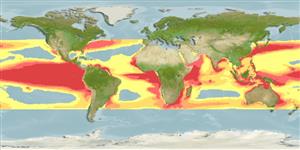
Circumglobal in tropical seas. Indian Ocean: off South Africa, Bay of Bengal, and probably Indonesia (Ref. 9911). Eastern Central Pacific: From Gulf of California to Chile (Ref. 130539).
Länge bei der ersten Reifung / Größe / Gewicht / Alter
Geschlechtsreife: Lm 163.6, range 146 - ? cm
Max length : 220 cm WD Männchen/unbestimmt; (Ref. 2850); common length : 150 cm WD Männchen/unbestimmt; (Ref. 9256)
Kurzbeschreibung
Bestimmungsschlüssel | Morphologie | Morphometrie
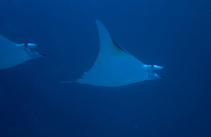
A moderate-sized devilray with a short head bearing short head fins; dorsal fin white-tipped, and pectoral fins with swept-back tips and a prominent double bend to the front margins; upper disc sparsely covered with small, blunt denticles and tail shorter than disc, with no spine (Ref. 5578). Dark blue to black above; white below, with silvery pectoral fin tips (Ref. 5578). No caudal fin (Ref. 5578).
Body shape (shape guide): other.
Occurs in coastal and oceanic waters, but more common near the coast (Ref. 9256). Found singly or in small groups (Ref. 12951). Feeds mainly on planktonic crustaceans (Ref. 12951); mostly small shrimp-like animals (Ref.58048). Ovoviviparous (Ref. 50449). Caught occasionally in the tuna gillnet and in harpoon fisheries. Utilized for its gill filter plates (high value), meat, cartilage and skin (Ref.58048). Can leap out of the water.
Exhibit ovoviparity (aplacental viviparity), with embryos feeding initially on yolk, then receiving additional nourishment from the mother by indirect absorption of uterine fluid enriched with mucus, fat or protein through specialised structures (Ref. 50449). With one large offspring per gestation period. Size at birth 65-85 cm (Ref. 6871).
Last, P.R. and J.D. Stevens, 1994. Sharks and rays of Australia. CSIRO, Australia. 513 p. (Ref. 6871)
IUCN Rote Liste Status (Ref. 130435: Version 2025-2 (Global))
Bedrohung für Menschen
Harmless
Nutzung durch Menschen
Fischereien: weniger kommerziell
Tools
Zusatzinformationen
Download XML
Internet Quellen
Schätzungen auf der Grundlage von Modellen
Bevorzugte Temperatur (Ref.
123201): 21.6 - 29.1, mean 27.8 °C (based on 2652 cells).
Phylogenetischer Diversitätsindex (Ref.
82804): PD
50 = 0.5020 [Uniqueness, from 0.5 = low to 2.0 = high].
Bayesian length-weight: a=0.01000 (0.00244 - 0.04107), b=3.04 (2.81 - 3.27), in cm total length, based on all LWR estimates for this body shape (Ref.
93245).
Trophische Ebene (Ref.
69278): 3.1 ±0.30 se; based on food items.
Widerstandsfähigkeit (Ref.
120179): sehr niedrig, Verdopplung der Population dauert mehr als 14 Jahre. (Fec=1).
Anfälligkeit der Fischerei (Ref.
59153): Very high vulnerability (83 of 100).
🛈
Nährstoffe (Ref.
124155): Calcium = 7.99 [1.05, 135.60] mg/100g; Iron = 0.83 [0.08, 10.24] mg/100g; Protein = 20.6 [15.3, 25.9] %; Omega3 = 0.157 [0.047, 0.501] g/100g; Selenium = 22.8 [4.7, 120.5] μg/100g; VitaminA = 4.56 [0.35, 57.84] μg/100g; Zinc = 0.483 [0.030, 5.484] mg/100g (wet weight);