Klassifizierung / Names
Namen | Synonyme | Catalog of Fishes(Gattung, Arten) | ITIS | CoL | WoRMS | Cloffa
Umwelt: Milieu / Klimazone / Tiefenbereich / Verbreitungsgebiet
Ökologie
; süßwasser; brackwasser demersal; potamodrom (Ref. 116361); tiefenbereich 5 - 9 m (Ref. 117245). Temperate; 60°N - 30°N, 100°W - 71°W
North America: St. Lawrence-Great Lakes, Hudson Bay, and Mississippi River basins.
Länge bei der ersten Reifung / Größe / Gewicht / Alter
Geschlechtsreife: Lm 99.7, range 90 - 120 cm
Max length : 274 cm TL Männchen/unbestimmt; (Ref. 5723); common length : 97.5 cm TL Männchen/unbestimmt; (Ref. 12193); max. veröff. Gewicht: 125.0 kg (Ref. 3672); max. veröff. Alter: 152 Jahre (Ref. 72475)
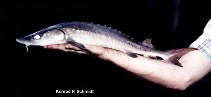
Single row of preanal shields. Soft area on the top of the head absent and black viscera. Large blotches present on anterior half of upper surface of snout and on back. Lower surface whitish (Ref. 37032). Anal fin origin behind dorsal fin origin; scutes on back and along side same color as skin (Ref. 86798).
Body shape (shape guide): elongated.
Adults inhabit bottom of lakes and large rivers (Ref. 10294), usually in 5-9 m depth, over mud, sand, and gravel. Occasionally enters brackish water. A specimen caught in 1952 was reputed to have been 152 years old (Ref. 6866). Search for food, with the aid of the sensory ability of the barbels, by constantly moving close to the substrate. Omnivorous, virtually anything edible that enters the mouth is sucked up and consumed. The food is worked or pulled in the mouth, often partly ejected and sucked in again (Ref. 1998). Spawning sites are rocky and boulder filled areas along the outside bend of rivers (Ref. 41542). In the 1800s, it was extensively exploited for oil to fire boilers on steamboats, animal feed and fertilizer. Later is was high-valued as smoked, caviar and isinglass (Ref. 117245). In 1951, Canada, 2,000 lbs. of caviar were made from the eggs (Ref. 37032). It continous to be an important source of food for Indigenous people in North America (Ref. 117245). Threatened due to over harvesting, habitat loss and pollution (Ref. 58490).
Spawning sites are rocky and boulder filled areas along the outside bend of rivers (Ref. 41542).
Page, L.M. and B.M. Burr, 1991. A field guide to freshwater fishes of North America north of Mexico. Houghton Mifflin Company, Boston. 432 p. (Ref. 5723)
IUCN Rote Liste Status (Ref. 130435: Version 2025-2 (Global))
Bedrohung für Menschen
Harmless
Nutzung durch Menschen
Fischereien: kommerziell; Aquakultur: experimental; Sportfisch: ja; Aquarium: Öffentliche Aquarien
Tools
Zusatzinformationen
Download XML
Internet Quellen
Schätzungen auf der Grundlage von Modellen
Phylogenetischer Diversitätsindex (Ref.
82804): PD
50 = 0.5000 [Uniqueness, from 0.5 = low to 2.0 = high].
Bayesian length-weight: a=0.00269 (0.00214 - 0.00339), b=3.18 (3.13 - 3.23), in cm total length, based on LWR estimates for this species (Ref.
93245).
Trophische Ebene (Ref.
69278): 3.3 ±0.49 se; based on food items.
Widerstandsfähigkeit (Ref.
120179): sehr niedrig, Verdopplung der Population dauert mehr als 14 Jahre. (tm=16-26; tmax=152; K=0.04; Fec=50,000).
Anfälligkeit der Fischerei (Ref.
59153): Very high vulnerability (86 of 100).
🛈