>
Amiiformes (Bowfins) >
Amiidae (Bowfins)
Etymology: Amia: Greek, amia = a kind of shark (Ref. 45335); calva: calva (Latin) = smooth or 'the bald scalp of the head', probably referring to the smooth appearance of the head of live specimens (Ref. 46234).
More on author: Linnaeus.
البيئة: الوسط / المنطقة المناخية / نطاق العمق / نطاق التوزيع
البيئة
; المياه العذبة القاع; سمكة نهرية (Ref. 126106). Subtropical; 15°C - 20°C (Ref. 2060); 47°N - 25°N, 97°W - 70°W (Ref. 86798)
North America: from the Pearl River in Louisiana and Mississippi, USA to the Florida Peninsula, and the rivers draining to the Atlantic Ocean in Georgia, South Carolina, North Carolina and Virginia, USA (Ref. 132277). Introduced sparingly elsewhere, including on Atlantic Slope north to Massachusetts, USA Ref. 86798).
الطول عند النضج الأول / الحجم / وزن / العمر
النضج: Lm 53.0, range 38 - 68 cm
Max length : 109 cm TL ذكر/ مختلط الجنس; (Ref. 86798); common length : 53.4 cm TL ذكر/ مختلط الجنس; (Ref. 12193); أعلا وزن تم نشرة: 9.8 kg (Ref. 4699); العمر: 30 سنين (Ref. 72462)
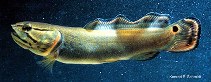
الأشواك الظهرية (المجموع) : 0; الأشعة الظهرية الناعمة (المجموع) : 42 - 53; شوكة شرجية: 0; أشعه شرجية لينه: 9 - 12; فقرات: 80 - 90. Branchiostegal rays: 10-12. Body is long and robust. Head is conic, mouth large, with maxillary extending well past eye; jaws wit strong, conical teeth; anterior nostrils at base of short barbels. Dorsal fin origin at 1/3 of total length; anal fin origin at midpoint of dorsal base; pelvic fins inserted at midpoint of body.
Pigmentation: Dark olive above combines with lighter color on sides to form reticulated pattern; venter cream or greenish; head yellow to brown with darker horizontal bars; lower fins vivid green; caudal light olive with irregular darker vertical bars. Adult males with prominent yellow to orange bordered black spot at upper caudal base, less intense or absent in females.
Body shape (shape guide): elongated.
Facultative air-breathing (Ref. 126274); Adults inhabit swamps, sloughs, lakes, and pools and backwaters of lowland streams (Ref. 86798). They are usually found near vegetation (Ref. 86798). They are air-breathers that can withstand high temperatures, which enable them to survive in stagnant areas; even known to aestivate; lethal temperature is 35.2°C (Ref. 46234). They are voracious and opportunist feeders, subsisting on fishes including other sport fishes, frogs, crayfish, insects, and shrimps. It uses scent as much as sight and captures food by means of gulping water. Small juveniles eat microcrustaceans and insects (Ref. 93252). Males are always smaller than females which live longer. Apparently somewhat migratory during spawning season (Ref. 4639). Eggs are adhesive, attached to decaying vegetation and upright weeds (Ref. 4639). Larvae are found in nest, remaining attached to roots or lying on bottom until adhesive organ is absorbed, thereafter in tight "swarm" guarded by male parent outside nest (Ref. 4639). A 'living fossil' and lone survivor species of Family Amiidae.
Males build and guard nest and young, usually nesting in colonies, and clearing out vegetation for the nest (Refs. 205, 34296, 34297, 3672). Most active at twilight and dawn (Ref. 34297); spawn at night (Ref. 34296). Eggs hatch in 9 days; newly hatched young measuring 8 mm (Ref. 34297). Larvae are guarded by the male parent until they are able to swim freely (Ref. 205).
Page, L.M. and B.M. Burr, 2011. A field guide to freshwater fishes of North America north of Mexico. Boston : Houghton Mifflin Harcourt, 663p. (Ref. 86798)
حالة القائمة الحمراء للاتحاد الدولي لحفظ الطبيعة والموارد الطبيعية (Ref. 130435: Version 2025-2 (Global))
استخدامات بشرية
مصائد: غير ذات اهمية; لعبة سمكه: نعم; حوض مائي: احواض مائية عامة
أدوات
تقارير خاصة
تنزيل XML
مصادر علي الأنترنت
تقديرات تستند إلى النماذج
مؤشر التنوع الشُعبي الوراثي (مرجع
82804): PD
50 = 1.2520 [Uniqueness, from 0.5 = low to 2.0 = high].
Bayesian length-weight: a=0.00437 (0.00165 - 0.01157), b=3.11 (2.88 - 3.34), in cm total length, based on LWR estimates for this (Sub)family-body shape (Ref.
93245).
مستوى غذائي (مرجع
69278): 3.8 ±0.67 se; based on food items.
المرونه (مرجع
120179): منخفض, الحد الزمني الأدني لتضاعف عدد أفراد المجتمع 4.5-14 سنة (K=0.14; tm=3-5; tmax=13; Fec=23,600).
ضعف الصيد (Ref.
59153): Moderate to high vulnerability (50 of 100).
🛈