>
Elopiformes (Tarpons and tenpounders) >
Elopidae (Tenpounders)
Etymology: Elops: Greek, ellops = a kind of serpent (Ref. 45335).
More on author: Regan.
Entorno: milieu / zona climática / rango de profundidad / gama de distribución
Ecología
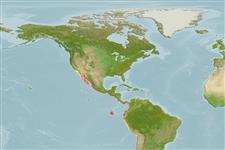
marino; salobre pelagic-neritic; oceanodromo (Ref. 51243); rango de profundidad 0 - 10 m (Ref. 96339). Subtropical; 36°N - 19°S, 122°W - 70°W (Ref. 118622)
Eastern Pacific: Mandalay Beach, southern California, USA to Peru, including the Gulf of California.
Tamaño / Peso / Edad
Madurez: Lm ? range ? - ? cm
Max length : 91.0 cm TL macho / no sexado; (Ref. 28050); common length : 50.0 cm TL macho / no sexado; (Ref. 9297)
Descripción breve
Claves de identificación | Morfología | Morfometría
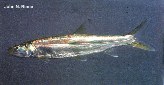
Espinas dorsales (total) : 0; Radios blandos dorsales (total) : 20 - 27; Espinas anales: 0; Radios blandos anales: 12 - 18; Vértebra: 78 - 82. Body slender and elongate; mouth large and terminal; bony plate present between branches of lower jaw; branchiostegal rays very numerous (25 to 35); fins lacking spines; lower branch of first gill arch with 16 to 20 gill rakers; scales very small, 100 to 120 in the lateral line; back dark blue-green to light brown; flanks silvery with slight yellow highlights; fins slightly yellowish (ref. 55763). Caudal rays: principal (10+8-9), procurrent (upper:8, lower: 8)
Branchiostegal rays: 23-35
Body shape (shape guide): elongated; Cross section: compressed.
Occur in schools in shallow inshore areas. Penetrate lagoons and estuaries (Ref. 9297). Feed on fish and penaeids (Ref. 50313). Spawning probably occur in the open sea and the transparent larvae migrate towards coastal areas (Ref. 9297). Struggle vigorously when caught on hooks and lines (Ref. 9297). Low commercial value due its numerous spines (Ref. 9297).
Ciclo vital y comportamiento de apareamiento
Madurez | Reproducción | Puesta | Huevos | Fecundidad | Larva
Eschmeyer, W.N., E.S. Herald and H. Hammann, 1983. A field guide to Pacific coast fishes of North America. Boston (MA, USA): Houghton Mifflin Company. xii+336 p. (Ref. 2850)
Situación en la Lista Roja de la UICN (Ref. 130435: Version 2025-2 (Global))
Amenaza para el ser humano
Harmless
Usos humanos
Pesquerías: escaso valor comercial; pesca deportiva: si
Herramientas
Informes especiales
Descargar XML
Fuentes de Internet
Estimaciones basadas en modelos
Temperatura preferida (Referencia
123201): 20.4 - 29.1, mean 25.1 °C (based on 257 cells).
Índice de diversidad filogenética (Referencia
82804): PD
50 = 0.5176 [Uniqueness, from 0.5 = low to 2.0 = high].
Bayesian length-weight: a=0.00617 (0.00269 - 0.01415), b=2.99 (2.80 - 3.18), in cm total length, based on LWR estimates for this (Sub)family-body shape (Ref.
93245).
Nivel trófico (Referencia
69278): 4.1 ±0.70 se; based on food items.
Vulnerabilidad pesquera (Ref.
59153): High vulnerability (56 of 100).
🛈
Nutrientes (Ref.
124155): Calcium = 57.4 [34.6, 127.5] mg/100g; Iron = 1.01 [0.59, 1.75] mg/100g; Protein = 17.7 [15.2, 20.7] %; Omega3 = 0.24 [0.13, 0.45] g/100g; Selenium = 17.6 [8.6, 38.9] μg/100g; VitaminA = 9.51 [3.42, 26.87] μg/100g; Zinc = 0.776 [0.556, 1.096] mg/100g (wet weight);