分類 / 名前
共通名の | 類義語 | Catalog of Fishes(部類, 種) | ITIS | CoL | WoRMS | Cloffa
>
Anguilliformes (Eels and morays) >
Muraenidae (Moray eels) > Muraeninae
Etymology: Echidna: Greek, echidna = viper, 1847 (Ref. 45335).
Eponymy: In Greek mythology Echidna was a female monster, and mother of many other monsters including the Hydra. Hesiod described her as “half a nymph with glancing eyes and fair cheeks, and half again a huge snake, great and awful, with speckled skin.” (Ref. 128868), visit book page.
More on author: Bloch.
環境:環境 / 気候帯 / 深さの範囲 / 分布範囲
生態学
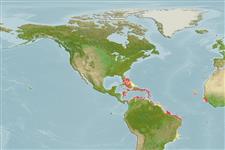
海 関連する礁; 深さの範囲 0 - 12 m (Ref. 9710), usually 0 - 2 m (Ref. 40849). Tropical; 33°N - 30°S, 82°W - 14°W
Western Atlantic: Bermuda, Florida (USA), and the Bahamas to the Antilles (Ref. 26340) and Brazil. Eastern Atlantic: Cape Verde (Ref. 34514) and Ascension Island (Ref. 4450). The only record from West Africa is probably erroneous (Ref. 4450). Also southern Atlantic islands (Ref. 26938).
サイズ / 重さ / 年齢
成熟: Lm ? range ? - ? cm
Max length : 165 cm TL オス/雌雄の選別がない; (Ref. 26340); common length : 40.0 cm TL オス/雌雄の選別がない; (Ref. 5217)
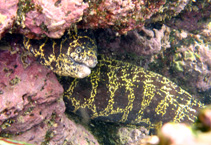
With short blunt snout, yellow chain-like markings, teeth bluntly pointed or molar-like especially on roof of mouth (Ref. 26938).
Body shape (shape guide): eel-like.
A benthic and solitary species (Ref. 26340) found commonly on reefs and rocky shore areas. Feeds on small fishes and crustaceans (Ref. 5521). At Fernando de Noronha Archipelago, off NE Brazil, forages for sally lightfoot crabs (Grapsus grapsus) on exposed reefs at ebb tide and in tide-pools mostly at daytime. Able to withstand up to 30 minutes out of water while foraging, uses four main tactics both in and out of the water. Searches for prey at pool rims and rock bases poking into crevices and holes, stealthily approaches previously sighted prey, chases prey and ambushes prey from under rocks and crevices. Hunting success varies with employed tactic, but overall success is about 50%. May move up to 6 meters in about 1 hour while foraging on the exposed reef. Its crab hunting is mostly visually guided and a fish darting nearby a stealthily foraging moray may cause it to miss the strike; the missed crab may be chased up to 5 m on the reef. Able to strike with its body partly or entirely out of the water, usually strikes from a distance of 5 to10 centimeters. Small crabs are swallowed whole, whereas larger ones are torn apart by a combination of tugging, rotating, knotting, and thrashing movements. Handling time is related to prey size, the largest crabs (carapace width 2.3-3.2 times larger than moray’s head width) broken up and swallowed within 90 to 240 seconds. Attracted to plastic or rubber decoys dragged on a nylon string nearby, striking at these (Ref. 50922).
ライフサイクルと交尾行動
成熟 | 繁殖 | 放精 | 卵 | 生産力 | 幼生
Robins, C.R. and G.C. Ray, 1986. A field guide to Atlantic coast fishes of North America. Houghton Mifflin Company, Boston, U.S.A. 354 p. (Ref. 7251)
IUCNのレッドリストの状況は (Ref. 130435: Version 2025-2 (Global))
人間の用途
水産業: 少数商業の; 水族館・水槽: 商業
用具
特記事項
XMLをダウンロードして下さい
インターネットの情報源
モデルに基づく推定値
好ましい温度 (参照
123201): 26.1 - 28.1, mean 27.4 °C (based on 527 cells).
系統多様性指数 (参照
82804): PD
50 = 0.5005 [Uniqueness, from 0.5 = low to 2.0 = high].
Bayesian length-weight: a=0.00049 (0.00024 - 0.00099), b=3.26 (3.09 - 3.43), in cm total length, based on LWR estimates for this (Sub)family-body shape (Ref.
93245).
栄養段階 (参照
69278): 3.6 ±0.59 se; based on food items.
回復力 (参照
120179): 非常に低い, 14年以上の倍増期間の最小個体群 (Preliminary K or Fecundity.).
漁業の脆弱性 (Ref.
59153): Very high vulnerability (90 of 100).
🛈
栄養素 (Ref.
124155): Calcium = 22.6 [11.1, 35.5] mg/100g; Iron = 0.395 [0.221, 0.871] mg/100g; Protein = 18.8 [16.4, 21.4] %; Omega3 = 0.0759 [, ] g/100g; Selenium = 41.4 [20.4, 88.3] μg/100g; VitaminA = 44.8 [10.8, 165.3] μg/100g; Zinc = 0.937 [0.641, 1.355] mg/100g (wet weight);