>
Eupercaria/misc (Various families in series Eupercaria) >
Lutjanidae (Snappers) > Lutjaninae
Etymology: Lutjanus: Malay, ikan lutjan, name of a fish.
More on author: Forsskål.
Окружающая среда: среда / климатическая зона / пределы глубины / диапазон распространения
экология
морской; солоноватоводный ассоциированный с рифами; пределы глубины 3 - 35 m (Ref. 9710). Tropical; 31°N - 35°S, 20°E - 134°W (Ref. 55)
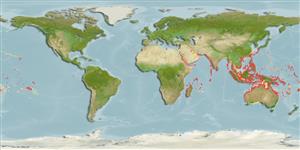
Indo-Pacific: Red Sea (Ref. 4320), Persian Gulf (Ref. 94051) and East Africa to Samoa, north to the Ryukyu Islands, south to Australia.
Длина при первой зрелости / Размер / Вес / Возраст
половая зрелость: Lm 19.1, range 12 - ? cm
Max length : 50.0 cm TL самец/пол неопределен; (Ref. 129178); common length : 30.0 cm TL самец/пол неопределен; (Ref. 5450); наибольший возраст (опубликованны данные): 23 годы (Ref. 2290)
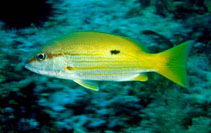
колючие лучи спинного плавника (общее число) : 10; членистые (мягкие) лучи спинного плавника (общее число) : 12 - 14; колючие лучи анального плавника: 3; членистые (мягкие) лучи анального плавника: 8. This species is distinguished by the following characters: body moderately deep; greatest depth 2.6-2.9 in SL; preopercular notch and knob poorly developed; vomerine tooth patch triangular or diamond-shaped, with a medial posterior extension; gill rakers of first gill arch 6-7 + 9-12 (including rudiments) = 16-19; caudal fin truncate to slightly emarginate; scale rows on back rising obliquely above lateral line. Colour of back and upper sides brown, lower sides whitish or light brown and belly whitish to yellow, usually a series of 6-7 yellow stripes on the sides and a prominent black spot at level of lateral line, below base of anterior part of soft portion of dorsal fin (Ref. 9821, 90102).
Body shape (shape guide): fusiform / normal; Cross section: oval.
Adults inhabit coral reefs (Ref. 30573, 58652), usually in schools on coastal reefs and in deep lagoons (Ref. 48635). Often in large aggregations with Lutjanus kasmira and Lutjanus lutjanus (Ref. 9710). Juveniles are sometimes found in mangrove estuaries or in the lower reaches of freshwater streams. Feed mainly on fishes, shrimps, crabs and other crustaceans (Ref. 30573). Caught mainly with handlines, traps, and gill nets. A small species, commonly utilized in subsistence fisheries but also seen frequently in markets where it is sold usually fresh (Ref. 9821). Neither anterolateral glandular groove nor venom gland is present (Ref. 57406, information in the table as dangerous fish, does not match; needs verification).
Allen, G.R., 1985. FAO Species Catalogue. Vol. 6. Snappers of the world. An annotated and illustrated catalogue of lutjanid species known to date. FAO Fish. Synop. 125(6):208 p. Rome: FAO. (Ref. 55)
Статус Красного Списка МСОП (Ref. 130435: Version 2025-2 (Global))
Угроза для людей
Reports of ciguatera poisoning (Ref. 30298)
Использование человеком
рыболовство: коммерческий; объект спортивного рыболовства: да; аквариум: общественные аквариумы
дополнительная информация
инструменты
Специальные отчеты
Скачать в формате XML
ресурсы в Интернет
Оценки, основанные на моделях
Предпочтительная температура (ссылка
123201): 24.7 - 29.1, mean 28.1 °C (based on 1044 cells).
Индекс филогенетического разнообразия (ссылка
82804): PD
50 = 0.5000 [Uniqueness, from 0.5 = low to 2.0 = high].
Bayesian length-weight: a=0.01549 (0.01375 - 0.01745), b=2.97 (2.95 - 2.99), in cm total length, based on LWR estimates for this species (Ref.
93245).
Трофический уровень (ссылка
69278): 3.8 ±0.3 se; based on diet studies.
устойчивость к внешним воздействиям (ссылка
120179): низкий, минимальное время удвоения популяции 4.5-14 лет (K=0.15-1.0; tmax=23; tm=1.6; Fec>45.000).
Уязвимость рыбной ловли (Ref.
59153): Moderate vulnerability (40 of 100).
🛈
Климатическая уязвимость (Ref.
125649): Moderate vulnerability (40 of 100).
🛈
Питательные вещества (Ref.
124155): Calcium = 52.7 [35.4, 78.7] mg/100g; Iron = 0.428 [0.266, 0.685] mg/100g; Protein = 18.9 [17.4, 20.2] %; Omega3 = 0.145 [0.101, 0.212] g/100g; Selenium = 57.3 [35.1, 97.3] μg/100g; VitaminA = 101 [18, 389] μg/100g; Zinc = 0.609 [0.464, 0.858] mg/100g (wet weight); based on
nutrient studies.