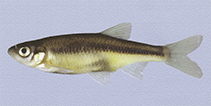
Tropidophoxinellus hellenicus

You can sponsor this page

Tropidophoxinellus hellenicus (Stephanidis, 1971)

Envoyez vos Photos et vidéos
Images | Images Google
Image of Tropidophoxinellus hellenicus
Tropidophoxinellus hellenicus
Photo de Thanasakis Dimitrios

Classification / Noms Noms communs | Synonymes | Catalog of Fishes(Genre, Espèce) | ITIS | CoL | WoRMS | Cloffa

> Cypriniformes (Carps) > Leuciscidae (Minnows) > Leuciscinae
Etymology: Tropidophoxinellus: Greek, trope, -idos = turn + Greek, phoxinos = certain river fish; diminituve (Ref. 45335).

Environnement : milieu / zone climatique / profondeur / gamme de distribution Écologie

; eau douce benthopélagique. Subtropical

Distribution Territoires | Zones FAO | Écosystèmes | Occurrences | Carte par point | Introductions | Faunafri

Europe: Acheloos and Pinios (Peloponnese) drainages in Greece.

Taille / Poids / Âge

Maturité: Lm ?  range ? - ? cm
Max length : 9.3 cm SL mâle / non sexé; (Ref. 59043)

Description synthétique Clés d'identification | Morphologie | Morphométrie

Diagnosed from Tropidophoxinellus spartiaticus by having mouth opening upward, lower jaw projecting beyond upper jaw, and 37-40 + scales along lateral line (Ref. 59043).
Body shape (shape guide): fusiform / normal.

Biologie     Glossaire (ex. epibenthic)

A short-lived species which occurs in lowland water courses with little current. Feeds on invertebrates and plants. Spawns from April to June (Ref. 26100). Lays adhesive eggs on aquatic vegetation. (Ref. 59043).

Cycle de vie et comportement reproducteur Maturité | Reproduction | Frai | Œufs | Fécondité | Larves

Référence principale Téléchargez vos références | Références | Coordinateur | Collaborateurs

Kottelat, M. and J. Freyhof, 2007. Handbook of European freshwater fishes. Publications Kottelat, Cornol and Freyhof, Berlin. 646 pp. (Ref. 59043)

Statut dans la liste rouge de l'IUCN (Ref. 130435: Version 2025-2 (Global))

  Quasi-menacé (NT) (B1b(iii)); Date assessed: 09 October 2023

CITES

Not Evaluated

CMS (Ref. 116361)

Not Evaluated

Menace pour l'homme

  Harmless


Utilisations par l'homme

Pêcheries: sans intérêt
FAO - Publication: search | FishSource |

Plus d'informations

Écologie trophique
Aliments (proies)
Composition du régime alimentaire
Consommation alimentaire
Rations alimentaires
Prédateurs
Écologie
Écologie
Dynamique des populations
Paramètres de croissance
Âges / tailles maximales
Longueur-poids rel.
Rel. longueur-longueur.
Fréquences de longueurs
Conversion de masse
Recrutement
Abondance
Cycle de vie
Reproduction
Maturité
Maturité/épines rel.
Fécondité
Frai
Agrégats de frai
Œufs
Développement de l'œuf
Larves
Dynamique des populations larvaires
Distribution
Territoires
Zones FAO
Écosystèmes
Occurrences
Introductions
BRUVS - Vidéos
Anatomie
Surface branchiale
Cerveau
Otolithe
Physiologie
Composition corporelle
Nutriments
Consommation d'oxygène
Type de natation
Vitesse de nage
Pigments visuels
Son de poisson
Maladies et parasites
Toxicité (CL50)
Génétique
génôme
Génétique
Hétérozygotie
Héritabilité
Diversité génétique
Liées à l'homme
Systèmes d'aquaculture
Profils d'aquaculture
Souches
Cas de ciguatera
Timbres, pièces de monnaie, divers
Sensibilisation
Collaborateurs
Taxonomie
Noms communs
Synonymes
Morphologie
Morphométrie
Images
Références
Références

Outils

Articles particuliers

Télécharger en XML

Sources Internet

AFORO (otoliths) | Aquatic Commons | BHL | Cloffa | Websites from users | FishWatcher | CISTI | Catalog of Fishes: Genre, Espèce | DiscoverLife | ECOTOX | FAO - Publication: search | Faunafri | Fishipedia | Fishtrace | GloBI | Google Books | Google Scholar | Google | IGFA World Record | OneZoom | Open Tree of Life | Otolith Atlas of Taiwan Fishes | PubMed | Reef Life Survey | Socotra Atlas | TreeBase | Arbre de Vie | Wikipedia: aller à, chercher | World Records Freshwater Fishing | Zoological Record

Estimations basées sur des modèles

Indice de diversité phylogénétique (Réf. 82804):  PD50 = 0.7500   [Uniqueness, from 0.5 = low to 2.0 = high].
Bayesian length-weight: a=0.00661 (0.00393 - 0.01110), b=3.11 (2.97 - 3.25), in cm total length, based on LWR estimates for this species & (Sub)family-body (Ref. 93245).
Niveau trophique (Réf. 69278):  2.7   ±0.28 se; based on food items.
Generation time: 1.5 ( na - na) years. Estimated as median ln(3)/K based on 1 growth studies.
Résilience (Réf. 120179):  Milieu, temps minimum de doublement de population : 1,4 à 4,4 années (tm=1-2; tmax=4; Fec=289-3,224).
Vulnérabilité de la pêche (Ref. 59153):  Low vulnerability (10 of 100). 🛈