Environnement : milieu / zone climatique / profondeur / gamme de distribution
Écologie
marin démersal. Subtropical
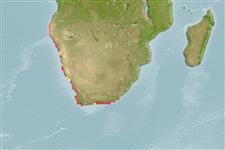
Southeast Atlantic: Lüderitzbucht, Namibia to west of Algoa Bay, South Africa.
Taille / Poids / Âge
Maturité: Lm ? range ? - ? cm
Max length : 13.0 cm TL mâle / non sexé; (Ref. 5496)
Description synthétique
Clés d'identification | Morphologie | Morphométrie
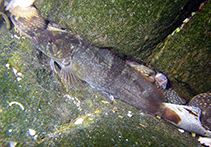
Épines dorsales (Total) : 30 - 34; Rayons mous dorsaux (Total) : 5 - 7; Épines anales: 2; Rayons mous anaux: 20 - 24. Light green in color, with crossbars or speckles; fins vermilion; dark ocellus on shoulder (Ref. 5496). Juveniles with black and white crossbars (Ref. 5496).
Body shape (shape guide): fusiform / normal.
Occurs in tide pools and subtidal areas. Viviparous (Ref. 51409).
Cycle de vie et comportement reproducteur
Maturité | Reproduction | Frai | Œufs | Fécondité | Larves
Smith, M.M., 1986. Clinidae. p. 758-769. In M.M. Smith and P.C. Heemstra (eds.) Smiths' sea fishes. Springer-Verlag, Berlin. (Ref. 5496)
Statut dans la liste rouge de l'IUCN (Ref. 130435: Version 2025-2 (Global))
Menace pour l'homme
Harmless
Utilisations par l'homme
Outils
Articles particuliers
Télécharger en XML
Sources Internet
Estimations basées sur des modèles
Température préférée (Réf.
123201): 15.5 - 21.9, mean 17.5 °C (based on 94 cells).
Indice de diversité phylogénétique (Réf.
82804): PD
50 = 0.5000 [Uniqueness, from 0.5 = low to 2.0 = high].
Bayesian length-weight: a=0.01096 (0.00421 - 0.02854), b=3.04 (2.82 - 3.26), in cm total length, based on LWR estimates for this (Sub)family-body shape (Ref.
93245).
Niveau trophique (Réf.
69278): 3.3 ±0.5 se; based on size and trophs of closest relatives
Résilience (Réf.
120179): Milieu, temps minimum de doublement de population : 1,4 à 4,4 années (Fec = 2,843).
Vulnérabilité de la pêche (Ref.
59153): Low vulnerability (10 of 100).
🛈