Klassifizierung / Names
Namen | Synonyme | Catalog of Fishes(Gattung, Arten) | ITIS | CoL | WoRMS | Cloffa
Umwelt: Milieu / Klimazone / Tiefenbereich / Verbreitungsgebiet
Ökologie
; süßwasser benthopelagisch. Tropical; 2°S - 7°S
Asia and Oceania: Widely distributed north of the central dividing range in the Markham, Gogol, Ramu, Sepik, and Mamberamo river systems in northeastern New Guinea.
Größe / Gewicht / Alter
Geschlechtsreife: Lm ? range ? - ? cm
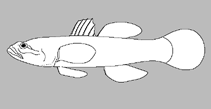
Max length : 10.0 cm SL Männchen/unbestimmt; (Ref. 2847)
Rückenflossenstacheln (insgesamt) : 8 - 10; Rückenflossenweichstrahlen (insgesamt) : 11 - 15; Afterflossenstacheln: 1; Afterflossenweichstrahlen: 11 - 15; Wirbelzahl: 32 - 34.
Body shape (shape guide): fusiform / normal.
Generally lives in slow-flowing, shaded streams, in rocky pools or well-vegetated sections. Also found in swampy areas. Occurs at altitudinal range from near sea level to at least 1200 m.
Lebenszyklus und Paarungsverhalten
Geschlechtsreife | Fortpflanzung | Ablaichen | Eier | Fruchtbarkeit | Larven
Allen, G.R. and D.R. Hoese, 1991. A review of the genus Mogurnda (Pisces: Eleotrididae) from New Guinea with descriptions of three new species. Ichthyol. Explor. Freshwat. 2(1):31-46. (Ref. 26739)
IUCN Rote Liste Status (Ref. 130435: Version 2025-2 (Global))
Bedrohung für Menschen
Harmless
Nutzung durch Menschen
Tools
Zusatzinformationen
Download XML
Internet Quellen
Schätzungen auf der Grundlage von Modellen
Phylogenetischer Diversitätsindex (Ref.
82804): PD
50 = 0.5000 [Uniqueness, from 0.5 = low to 2.0 = high].
Bayesian length-weight: a=0.00977 (0.00411 - 0.02324), b=3.08 (2.88 - 3.28), in cm total length, based on LWR estimates for this (Sub)family-body shape (Ref.
93245).
Trophische Ebene (Ref.
69278): 3.3 ±0.5 se; based on size and trophs of closest relatives
Widerstandsfähigkeit (Ref.
120179): hoch, Verdopplung der Population dauert weniger als 15 Monate. (Preliminary K or Fecundity.).
Anfälligkeit der Fischerei (Ref.
59153): Low vulnerability (10 of 100).
🛈