>
Eupercaria/misc (Various families in series Eupercaria) >
Lutjanidae (Snappers) > Lutjaninae
Etymology: Lutjanus: Malay, ikan lutjan, name of a fish.
Eponymy: Rev Dr Christoph Samuel John (1747–1813) was a botanist and herpetologist and a medical missionary (1771–1813) at the Danish trading station of Tranquebar (now Tharangambadi), Tamil Nadu, not far from Madras (Chennai). [...] (Ref. 128868), visit book page.
More on author: Bloch.
Ambiente: milieu / zona climatica / distribuzione batimetrica / gamma di distribuzione
Ecologia
marino; salmastro associati a barriera corallina; oceanodromo (Ref. 51243); distribuzione batimetrica 0 - 80 m (Ref. 30573). Tropical; 31°N - 30°S, 30°E - 174°W (Ref. 55)
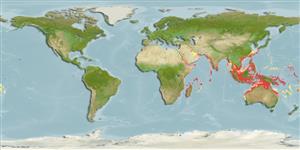
Indo-West Pacific: East Africa to Fiji, north to the Ryukyu Islands, south to Australia.
Lunghezza alla prima maturità / Dimensione / Peso / Età
Maturità: Lm 51.9 range ? - ? cm
Max length : 106 cm TL maschio/sesso non determinato; (Ref. 132370); common length : 50.0 cm TL maschio/sesso non determinato; (Ref. 55); peso massimo pubblicato: 28.5 kg (Ref. 132370)
Spine dorsali (totale) : 10; Raggi dorsali molli (totale) : 13 - 14; Spine anali: 3; Raggi anali molli: 8. Dorsal profile of head steeply sloped. Preorbital width equal to eye diameter or larger. Preopercular notch and knob poorly developed. Scale rows on back parallel to lateral line. Center of each scale often with a reddish-brown spot, giving an overall appearance of series of horizontal lines on side of body. Generally yellow with a bronze to silvery sheen, shading to silvery white on belly and underside of the head. A large black blotch mainly above the lateral line below the anterior dorsal-fin rays.
Body shape (shape guide): fusiform / normal; Cross section: oval.
Adults probably frequent coral reef areas; juveniles found in mangrove estuaries (Ref. 30573). Feed on fishes and benthic invertebrates including shrimps, crabs and cephalopods. In Hong Kong live fish markets (Ref. 27253).
Ciclo vitale e comportamento di accoppiamento
Maturità | Riproduzione | Deposizione | Uova | Fecondità | Larve
Allen, G.R., 1985. FAO Species Catalogue. Vol. 6. Snappers of the world. An annotated and illustrated catalogue of lutjanid species known to date. FAO Fish. Synop. 125(6):208 p. Rome: FAO. (Ref. 55)
Stato della Lista Rossa IUCN (Ref. 130435: Version 2025-2 (Global))
Minaccia per l'uomo
Harmless
Usi umani
Pesca: commerciale; Acquacoltura: commerciale; Pesce da pesca sportiva: si
Strumenti
Rapporti speciali
Scarica XML
Fonti Internet
Stime basate su modelli
Temperatura preferita (Fonte Biblio.
123201): 25 - 29.1, mean 28.2 °C (based on 1824 cells).
Indice di diversità filogenetica (Fonte Biblio.
82804): PD
50 = 0.5000 [Uniqueness, from 0.5 = low to 2.0 = high].
Bayesian length-weight: a=0.01514 (0.01350 - 0.01697), b=2.96 (2.94 - 2.98), in cm total length, based on LWR estimates for this species (Ref.
93245).
Livello trofico (Fonte Biblio.
69278): 4.2 ±0.6 se; based on diet studies.
Generation time: 6.9 (5.2 - 9.5) years. Estimated as median ln(3)/K based on 10
growth studies.
Resilienza (Fonte Biblio.
120179): Basso, tempo minimo di raddoppiamento della popolazione 4.5 - 14 anni (K=0.10-0.38; tmax=28.6).
Prior r = 0.40, 95% CL = 0.26 - 0.60, Based on 1 full stock assessment.
Vulnerabilità della pesca (Ref.
59153): High to very high vulnerability (65 of 100).
🛈
Vulnerabilità climatica (Ref.
125649): Very high vulnerability (90 of 100).
🛈
Nutrienti (Ref.
124155): Calcium = 19.6 [12.3, 28.3] mg/100g; Iron = 0.256 [0.165, 0.398] mg/100g; Protein = 18.9 [17.4, 20.2] %; Omega3 = 0.131 [0.095, 0.177] g/100g; Selenium = 69.1 [44.6, 104.8] μg/100g; VitaminA = 113 [19, 416] μg/100g; Zinc = 0.428 [0.346, 0.572] mg/100g (wet weight); based on
nutrient studies.