>
Gobiiformes (Gobies) >
Gobiidae (Gobies) > Gobionellinae
Etymology: Knipowitschia: Because of N.M.Knipowitsch, a zoologist and Russian ichthyologist from the Academy of Sciences. Expeditions in "Pomor" and "Pervosvanniy" ships to Azov and Black sea (1898-1908).
Eponymy: Nikolai Mikhailovich Knipovich (also given as Knipowitsch) (1862–1939) was a Russian oceanographer, marine zoologist and ichthyologist. [...] (Ref. 128868), visit book page.
Entorno: milieu / zona climática / rango de profundidad / gama de distribución
Ecología
; agua dulce demersal. Subtropical
Europe: Bosnia-Herzegovina: lower Neretva drainage. Croatia: upper Matica drainage, Neretva springs and Lake Bacina (Ref.13696, Ref.59043).
Tamaño / Peso / Edad
Madurez: Lm ? range ? - ? cm
Max length : 4.7 cm SL macho / no sexado; (Ref. 59043)
Descripción breve
Claves de identificación | Morfología | Morfometría
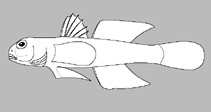
This species is distinguished from its congeners by the following characters: body of breeding males with 15-18 dark irregular bars; absence of cephalic lateral line canals; body scales only under pectoral; D1 6; D2 7.5 branched rays; A 9.5 branched rays (Ref. 59043).
Body shape (shape guide): fusiform / normal.
Occurs in clear karstic springs, lakes, slow-flowing streams and small rivers. Longevity is less than 2 years. Spawns after first winter with males defending the eggs in cavities under stones, plant material or shells. Juveniles are free swimming while adults are benthic. During summer droughts, this species may survive in underground waters (Ref.59043).
Ciclo vital y comportamiento de apareamiento
Madurez | Reproducción | Puesta | Huevos | Fecundidad | Larva
Kottelat, M., 1997. European freshwater fishes. An heuristic checklist of the freshwater fishes of Europe (exclusive of former USSR), with an introduction for non-systematists and comments on nomenclature and conservation. Biologia, Bratislava, 52/Suppl. 5:1-271. (Ref. 13696)
Situación en la Lista Roja de la UICN (Ref. 130435: Version 2025-2 (Global))
Amenaza para el ser humano
Harmless
Usos humanos
Herramientas
Informes especiales
Descargar XML
Fuentes de Internet
Estimaciones basadas en modelos
Índice de diversidad filogenética (Referencia
82804): PD
50 = 0.5000 [Uniqueness, from 0.5 = low to 2.0 = high].
Bayesian length-weight: a=0.01023 (0.00452 - 0.02316), b=3.00 (2.81 - 3.19), in cm total length, based on LWR estimates for this (Sub)family-body shape (Ref.
93245).
Nivel trófico (Referencia
69278): 3.4 ±0.4 se; based on size and trophs of closest relatives
Generation time: 0.7 ( na - na) years. Estimated as median ln(3)/K based on 1
growth studies.
Resiliencia (Referencia
120179): Alto, población duplicada en un tiempo mínimo inferior a 15 meses (Preliminary K or Fecundity.).
Vulnerabilidad pesquera (Ref.
59153): Low vulnerability (10 of 100).
🛈