Klassifizierung / Names
Namen | Synonyme | Catalog of Fishes(Gattung, Arten) | ITIS | CoL | WoRMS | Cloffa
>
Siluriformes (Catfishes) >
Bagridae (Bagrid catfishes)
Etymology: Mystus: Greek, mystax = whiskered, used by Belon in 1553 to describe all fishes with whiskers (Ref. 45335).
More on author: Roberts.
Umwelt: Milieu / Klimazone / Tiefenbereich / Verbreitungsgebiet
Ökologie
; süßwasser demersal; potamodrom (Ref. 51243). Tropical
Asia: Mekong and Chao Phraya basins (Ref. 27732). Reported from the Maeklong River (Ref. 26336).
Größe / Gewicht / Alter
Geschlechtsreife: Lm ? range ? - ? cm
Max length : 13.0 cm SL Männchen/unbestimmt; (Ref. 27732)
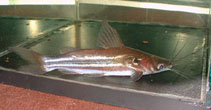
Afterflossenweichstrahlen: 13 - 15; Wirbelzahl: 34 - 37. Differs from all other species of Mystus in having eyes lateral, rather than dorsolateral, so that they are about equally visible viewed either from above or from below head (in other species eyes usually cannot be seen at all from directly below). Mouth nearly terminal, less downturned than in any other species of striped Mystus. Serrae of pectoral spine smaller and less erect than in any other striped Mystus. Adipose fin short but very high, originating far behind dorsal fin, its length about twice and its height slightly less than eye diameter. Gill rakers increase in number throughout life faster than in any other Mystus. The anal fin has slightly more rays (13-15) than other striped Mystus of Thailand (usually 12 or less), and its posterior border is distinctly falcate. Cranial fontanel extends posteriorly to about midway between level of posterior border of eye and base of supraoccipital process. Maxillary barbel extends posteriorly to beyond anal fin or to end of middle caudal fin rays (Ref. 26663). Side of body with 3 faint dark and 2 whitish stripes (Ref. 43281).
Body shape (shape guide): elongated.
Facultative air-breathing in the genus (Ref. 126274); Often found in mixed schools with M. multiradiatus which congregate around tree limbs and other solid objects, browsing the hard surfaces for zooplankton, aquatic insects, crustaceans and rotifers. Move into flooded forests during the rainy season and returns to rivers in November and December in the lower Mekong. Oviparous, distinct pairing possibly like other members of the same family (Ref. 205). Marketed fresh or smoked on a skewer (Ref. 12693).
Lebenszyklus und Paarungsverhalten
Geschlechtsreife | Fortpflanzung | Ablaichen | Eier | Fruchtbarkeit | Larven
Rainboth, W.J., 1996. Fishes of the Cambodian Mekong. FAO species identification field guide for fishery purposes. FAO, Rome, 265 p. (Ref. 12693)
IUCN Rote Liste Status (Ref. 130435: Version 2025-2 (Global))
Bedrohung für Menschen
Harmless
Nutzung durch Menschen
Fischereien: kommerziell
Tools
Zusatzinformationen
Download XML
Internet Quellen
Schätzungen auf der Grundlage von Modellen
Phylogenetischer Diversitätsindex (Ref.
82804): PD
50 = 0.5000 [Uniqueness, from 0.5 = low to 2.0 = high].
Bayesian length-weight: a=0.00813 (0.00354 - 0.01865), b=2.94 (2.77 - 3.11), in cm total length, based on LWR estimates for this Genus-body shape (Ref.
93245).
Trophische Ebene (Ref.
69278): 3.1 ±0.42 se; based on food items.
Widerstandsfähigkeit (Ref.
120179): mittel, Verdopplung der Population dauert 1,4 - 4,4 Jahre. (Assuming Fec < 10,000).
Anfälligkeit der Fischerei (Ref.
59153): Low vulnerability (10 of 100).
🛈