>
Cypriniformes (Carps) >
Nemacheilidae (Brook loaches)
Etymology: Schistura: Greek, schizein = to divide + Greek, oura = tail; an allusion to forked caudal fins (Ref. 45335); spiloptera: Spilotus (Latin): spotted; pteron (Greek): wing, fin.
More on author: Valenciennes.
Environnement : milieu / zone climatique / profondeur / gamme de distribution
Écologie
; eau douce démersal. Tropical
Asia: Vietnam. Reported from the Mekong basin (Ref. 26580).
Taille / Poids / Âge
Maturité: Lm ? range ? - ? cm
Max length : 5.2 cm SL mâle / non sexé; (Ref. 40772)
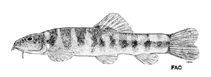
Differs from its congeners in Indochina by the combination of the following characters; processus dentiformis present; caudal fin with 9+8 branched rays; pelvic fin with 8 rays; complete lateral line; color pattern with 9-13 dark bars on body, regularly shaped and set; complete black bar at caudal fin base thin, reaching dorsal and ventral midlines in some specimens; axillary pelvic lobe present; pelvic fin situated under branched rays 1-2 of dorsal fin; body elongated and head depressed; caudal peduncle 1.2-1.4 times longer than deep; axillary pelvic lobe small; caudal fin slightly emarginate and bright red in life, orange to hyaline in preserved specimens (Ref. 40772).
Body shape (shape guide): elongated.
Inhabits shallow, clear, fast-flowing water over rocky bottoms in upland streams. Seasonal movements slight, if they occur at all. Feeds on insect larvae, some algae and phytoplankton. Not caught commercially, but might have possibilities in the aquarium trade (Ref. 12693). A 4.32 cm SL female with ovulae 1.5 mm in diameter (Ref. 39226).
Cycle de vie et comportement reproducteur
Maturité | Reproduction | Frai | Œufs | Fécondité | Larves
Freyhof, J. and D.V. Serov, 2001. Nemacheiline loaches from Central Vietnam with descriptions of a new genus and 14 new species (Cypriniformes: Balitoridae). Ichthyol. Explor. Freshwat. 12(2):133-191. (Ref. 40772)
Statut dans la liste rouge de l'IUCN (Ref. 130435: Version 2025-2 (Global))
Menace pour l'homme
Harmless
Utilisations par l'homme
Outils
Articles particuliers
Télécharger en XML
Sources Internet
Estimations basées sur des modèles
Indice de diversité phylogénétique (Réf.
82804): PD
50 = 0.5000 [Uniqueness, from 0.5 = low to 2.0 = high].
Bayesian length-weight: a=0.00708 (0.00323 - 0.01553), b=3.03 (2.86 - 3.20), in cm total length, based on LWR estimates for this Genus-body shape (Ref.
93245).
Niveau trophique (Réf.
69278): 3.0 ±0.3 se; based on size and trophs of closest relatives
Résilience (Réf.
120179): Haut, temps minimum de doublement de population inférieur à 15 mois (Preliminary K or Fecundity.).
Vulnérabilité de la pêche (Ref.
59153): Low vulnerability (10 of 100).
🛈