分類 / 名稱
俗名 | 同種異名 | Catalog of Fishes(屬, 種) | ITIS | CoL | WoRMS | Cloffa
Teleostei >
Cypriniformes (Carps) >
Tincidae (Tenches)
Etymology: Tinca: Latin, timica; realted to a predatory fish = timi, but the etymology of tench does not conform with this meaning (Ref. 45335); tinca: tinca which is the latin name for tench (Ref. 1998).
More on author: Linnaeus.
環境: 環境 / 氣候帶 / 深度上下限 / 配送範圍
生態學
; 淡水; 半鹹淡水 居於水底的; 河川洄游 (Ref. 126106); 深度上下限 1 - ? m (Ref. 26368). 溫帶; 4°C - 24°C (Ref. 13614); 64°N - 36°N, 10°W - 104°E
Eurasia: hypothesized as native in most Europe, naturally absent only in Ireland, Scandinavia north of 61°30'N, eastern Adriatic basin and western and southern Greece where it is now introduced. In Asia, native eastward to western Yenisei drainage south of 60° N. Introduced elsewhere.
歐亞大陸: 所有歐洲, 包括不列顛群島。 北極海流域, 鄂比河與葉尼塞河流域, 而且極少在貝加爾湖.(參考文獻 1998)
初熟時的長度 / 大小 / 重量 / 年齡
成熟度: Lm ?, range 20 - ? cm
Max length : 70.0 cm SL 雄魚/尚未辨別雌雄; (Ref. 44894); common length : 20.0 cm TL 雄魚/尚未辨別雌雄; (Ref. 556); 最大體重: 7.5 kg (Ref. 556)
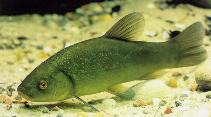
背棘 (總數) : 4; 背的軟條 (總數) : 8 - 9; 臀棘: 3 - 4; 臀鰭軟條: 6 - 8; 脊椎骨: 39 - 41. Body thickset, heavy, and laterally compressed, the caudal peduncle characteristically deep and short. Skin thickened, slimy; the scales small, embedded. Overall coloration olive-green, at times dark green or almost black, with golden reflections on ventral surface. Head triangular, eye orange-red, small; snout relatively long; interorbital broad; mouth terminal, small in size with thick lips and a pair of well-developed barbels, one at each corner of the mouth. Caudal fin with 19 rays (Ref. 2196). Diagnosed from other cyprinid species in Europe by the following characters: body golden greenish brown; one pair of barbel (maxillary); lateral line with 96-115 scales, small and deeply embedded; dorsal fin with 8-9½ branched rays; and anal fin with 6-9½ branched rays (Ref. 59043).
Body shape (shape guide): fusiform / normal.
身體矮胖的﹐重的﹐與側扁的, 尾梗表示特性深的而且短。 皮膚粗的, 黏滑的; 鱗片小的, 深入的。 整體的顏色橄欖綠色的, 偶而深綠色或幾乎黑色的, 在腹面上有金色的反光。 頭部三角形的, 眼橘紅色的, 小的; 吻相當長的; 眼間骨寬的; 口端位, 體型很小有厚的嘴唇而一對發展良好的觸鬚, 一在嘴巴的每個角落。 尾鰭有 19個鰭條。 (參考文獻 2196)
Typically found in shallow, densely vegetated lakes and backwaters. They often overwinter buried in mud. Larvae and juveniles confined to dense vegetation (Ref. 59043). Adults inhabit warm lakes and pools with weed and mud bottom. Tolerates low oxygen saturations (Ref. 30578, 44894). Feeds on detritus, benthic animals and plant materials. Adult often prey mainly on molluscs. They spawn among dense vegetation in still water (Ref. 59043). Used as a fodder fish for bass (Ref. 7248). Utilized fresh and frozen; eaten pan-fried, broiled, and baked (Ref. 9988). Popular with amateur sport fishers. Flesh is highly esteemed (Ref. 30578). Locally under threat due to river engineering (Ref. 59043). Reported to reach a maximum length of 84 cm TL (Ref. 5723).
用雜草與泥底成魚棲息於溫暖的湖與水池。 寬容的溶氧量低浸透.(參考文獻 30578,44894) 出現在靜止或流動很慢水域, 常見於茂密的植物之中.(參考文獻 44894) 冬天時,他們停留在沒有進食的泥中。 (參考文獻 30578) 雜食性。 成魚吃底棲無脊椎動物與水生的昆蟲幼生。 幼魚也吃藻類。 (參考文獻 1998,44894) 在被產很多的黏黏綠色的卵的茂密的植物之中的淺水區中繁殖。 在孵化之後,仔魚保持依附於植物長達好幾天。 為 bass 當作飼料魚.。 (參考文獻 7248) 生鮮使用與冷凍; 吃油鍋炸的, 烤的與烘乾的.(參考文獻 9988) 受到業餘釣客的歡迎。 它的肉是深受喜愛的。 (參考文獻 30578) 84 公分TL 的最大長度在頁 & 粗刻邊被報告。 (參考文獻 5723)
Males reproduce at 2-3 years and females at 3-7 years. Spawning happens, depending on latitude, between May and September, at temperatures of 19 20°C. Lays numerous sticky green eggs on plants or on the botton every 1 5 days for 2 months. Incubation at 20°C lasts 3 days. Larvae remain attached to the plants for several days until the vitellus is used up. Egg size 0.8-1.0 mm, larval length at hatching 4-5 mm.
歐亞大陸: 所有歐洲, 包括不列顛群島。 北極海流域, 鄂比河與葉尼塞河流域, 而且極少在貝加爾湖.(參考文獻 1998)
Kottelat, M. and J. Freyhof, 2007. Handbook of European freshwater fishes. Publications Kottelat, Cornol and Freyhof, Berlin. 646 pp. (Ref. 59043)
IUCN 瀕危狀態 (Ref. 130435: Version 2025-2 (Global))
無危 (LC) ; Date assessed: 27 October 2022
人類使用
漁業: 商業性; 養殖: 商業性; 游釣魚種: 是的; 水族館: 公眾的水族館
工具
特別的報告
下載 XML
網路資源
基於模型的估計
系統發育多樣性指數 (參考文獻
82804): PD
50 = 1.5000 [Uniqueness, from 0.5 = low to 2.0 = high].
Bayesian length-weight: a=0.01122 (0.00809 - 0.01557), b=3.02 (2.93 - 3.11), in cm total length, based on LWR estimates for this species (Ref.
93245).
營養階層 (參考文獻
69278): 3.7 ±0.0 se; based on diet studies.
Generation time: 8.9 ( na - na) years. Estimated as median ln(3)/K based on 2
growth studies.
回復力 (參考文獻
120179): 中等的, 族群倍增時間最少 1.4 - 4.4年 (tm=2; tmax=10; Fec=120,000-800,000).
釣魚的脆弱性 (Ref.
59153): High vulnerability (58 of 100).
🛈
營養素 (Ref.
124155): Calcium = 63.1 [30.7, 116.5] mg/100g; Iron = 0.745 [0.348, 1.410] mg/100g; Protein = 18.7 [16.8, 20.5] %; Omega3 = 0.696 [0.352, 1.429] g/100g; Selenium = 10.2 [5.2, 20.9] μg/100g; VitaminA = 16.9 [5.5, 52.5] μg/100g; Zinc = 0.948 [0.429, 1.762] mg/100g (wet weight); based on
nutrient studies.