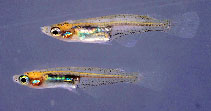
>
Beloniformes (Needle fishes) >
Adrianichthyidae (Ricefishes) > Oryziinae
Etymology: Oryzias: Greek, oryza = rice; because of the habitat used by this fish (Ref. 45335).
More on author: Smith.
Environnement : milieu / zone climatique / profondeur / gamme de distribution
Écologie
; eau douce benthopélagique; pH range: 7.5 - 8.5; non migrateur. Tropical; 22°C - 25°C (Ref. 31267)
Asia: Chao Phraya basin in Thailand and Malay Peninsula. China, Myanmar, Laos, Cambodia, Viet Nam.
Taille / Poids / Âge
Maturité: Lm ? range ? - ? cm
Max length : 2.0 cm TL mâle / non sexé; (Ref. 27139)
Description synthétique
Clés d'identification | Morphologie | Morphométrie
Rayons mous dorsaux (Total) : 5 - 7; Rayons mous anaux: 17 - 21; Vertèbres: 24 - 28. Principal caudal fin rays 4/5 (Ref. 27658); no orange margins on caudal fin (Ref. 43281).
Body shape (shape guide): elongated.
Inhabits clear water swamps (Ref. 43281). Non-annual breeder (Ref. 27139).
Cycle de vie et comportement reproducteur
Maturité | Reproduction | Frai | Œufs | Fécondité | Larves
Egg clusters are deposited among the vegetation.
Huber, J.H., 1996. Killi-Data 1996. Updated checklist of taxonomic names, collecting localities and bibliographic references of oviparous Cyprinodont fishes (Atherinomorpha, Pisces). Société Française d'Ichtyologie, Muséum National d'Histoire Naturelle, Paris, France, 399 p. (Ref. 27139)
Statut dans la liste rouge de l'IUCN (Ref. 130435: Version 2025-2 (Global))
Menace pour l'homme
Harmless
Utilisations par l'homme
Pêcheries: sans intérêt
Outils
Articles particuliers
Télécharger en XML
Sources Internet
Estimations basées sur des modèles
Indice de diversité phylogénétique (Réf.
82804): PD
50 = 0.5000 [Uniqueness, from 0.5 = low to 2.0 = high].
Bayesian length-weight: a=0.00479 (0.00190 - 0.01207), b=3.13 (2.91 - 3.35), in cm total length, based on LWR estimates for this (Sub)family-body shape (Ref.
93245).
Niveau trophique (Réf.
69278): 3.0 ±0.4 se; based on size and trophs of closest relatives
Résilience (Réf.
120179): Faible, temps minimum de doublement de population : 4,5 à 14 années (Assuming fec < 100).
Vulnérabilité de la pêche (Ref.
59153): Low vulnerability (10 of 100).
🛈