>
Pleuronectiformes (Flatfishes) >
Scophthalmidae (Turbots)
Etymology: Lepidorhombus: Greek, lepis = scale + Greek, rhombos = paralelogram (Ref. 45335).
Eponymy: Louis-Augustin Guillaume Bosc d’Antic (1759–1828) was a French naturalist and botanist. [...] (Ref. 128868), visit book page.
More on author: Risso.
Environnement : milieu / zone climatique / profondeur / gamme de distribution
Écologie
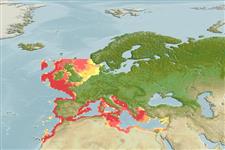
marin démersal; profondeur 7 - 800 m (Ref. 6501). Temperate; 70°N - 26°N, 15°W - 36°E
Northeast Atlantic: British Isles south to Cape Bojador, West Sahara and the Mediterranean.
Longueur à la première maturité / Taille / Poids / Âge
Maturité: Lm ? range ? - ? cm
Max length : 40.0 cm SL mâle / non sexé; (Ref. 4703); common length : 20.0 cm TL mâle / non sexé; (Ref. 3397); poids max. publié: 640.00 g (Ref. 86713)
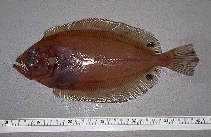
Épines dorsales (Total) : 0; Rayons mous dorsaux (Total) : 79 - 86; Rayons mous anaux: 65 - 69. Dorsal fin origin closer to tip of snout than to anterior edge of eye. Dorsal and anal fins terminate just a little on the blind side of the caudal peduncle. Lateral line forms a distinct curve above the pectoral fin.
Body shape (shape guide): fusiform / normal; Cross section: compressed.
Inhabits soft bottoms (Ref. 6501).
Distinct pairing during breeding (Ref. 205). A determinate spawner (Ref. 72169).
Nielsen, J.G., 1990. Scophthalmidae. p. 1026. In J.C. Quero, J.C. Hureau, C. Karrer, A. Post and L. Saldanha (eds.) Check-list of the fishes of the eastern tropical Atlantic (CLOFETA). JNICT, Lisbon; SEI, Paris; and UNESCO, Paris. Vol. 2. (Ref. 6501)
Statut dans la liste rouge de l'IUCN (Ref. 130435: Version 2025-2 (Global))
Menace pour l'homme
Harmless
Utilisations par l'homme
Pêcheries: intérêt commercial mineur
Outils
Articles particuliers
Télécharger en XML
Sources Internet
Estimations basées sur des modèles
Température préférée (Réf.
123201): 7.5 - 15.1, mean 11.5 °C (based on 292 cells).
Indice de diversité phylogénétique (Réf.
82804): PD
50 = 0.7520 [Uniqueness, from 0.5 = low to 2.0 = high].
Bayesian length-weight: a=0.00457 (0.00374 - 0.00559), b=3.12 (3.06 - 3.18), in cm total length, based on LWR estimates for this species (Ref.
93245).
Niveau trophique (Réf.
69278): 3.7 ±0.3 se; based on diet studies.
Generation time: 5.6 (5.0 - 6.1) years. Estimated as median ln(3)/K based on 38
growth studies.
Résilience (Réf.
120179): Milieu, temps minimum de doublement de population : 1,4 à 4,4 années (K=0.14-0.26; tmax=13).
Prior r = 0.33, 95% CL = 0.22 - 0.49, Based on 4 full stock assessments.
Vulnérabilité de la pêche (Ref.
59153): Moderate to high vulnerability (48 of 100).
🛈
Vulnérabilité climatique (Ref.
125649): Low to moderate vulnerability (30 of 100).
🛈
Nutriments (Ref.
124155): Calcium = 39.8 [20.1, 67.5] mg/100g; Iron = 0.311 [0.126, 0.628] mg/100g; Protein = 19.7 [17.8, 21.4] %; Omega3 = 0.676 [0.299, 1.641] g/100g; Selenium = 15.2 [5.7, 41.6] μg/100g; VitaminA = 14.5 [4.2, 47.1] μg/100g; Zinc = 0.417 [0.234, 0.828] mg/100g (wet weight); based on
nutrient studies.