Umwelt: Milieu / Klimazone / Tiefenbereich / Verbreitungsgebiet
Ökologie
seewasser demersal; tiefenbereich 0 - 2 m (Ref. 10682). Tropical
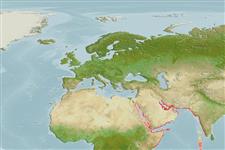
Western Indian Ocean: Persian Gulf to southern Oman.
Größe / Gewicht / Alter
Geschlechtsreife: Lm ? range ? - ? cm
Max length : 14.5 cm TL Männchen/unbestimmt; (Ref. 11441)
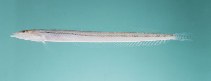
Rückenflossenstacheln (insgesamt) : 3 - 4; Rückenflossenweichstrahlen (insgesamt) : 44 - 47; Afterflossenstacheln: 1; Afterflossenweichstrahlen: 36 - 39; Wirbelzahl: 52 - 54. Females with an indistinct narrow dark stripe on body above lateral line and no black on anterior part of dorsal fin; males with a longitudinal row of 14 brown spots and 3 rows of small, dark edged, pale blue spots on body; dorsal and anal fins with a row of yellow dots on each membrane.
Body shape (shape guide): elongated.
Feeds on zooplankton about half a meter above the sand substratum (Ref. 10682).
Lebenszyklus und Paarungsverhalten
Geschlechtsreife | Fortpflanzung | Ablaichen | Eier | Fruchtbarkeit | Larven
Randall, J.E. and A.B. Tarr, 1994. Trichonotus arabicus (Perciformes: Trichonotidae), a new species of sand diver from the Arabian Gulf and Oman. Fauna of Saudi Arabia 14:309-316. (Ref. 10682)
IUCN Rote Liste Status (Ref. 130435: Version 2025-2 (Global))
Bedrohung für Menschen
Harmless
Nutzung durch Menschen
Tools
Zusatzinformationen
Download XML
Internet Quellen
Schätzungen auf der Grundlage von Modellen
Bevorzugte Temperatur (Ref.
123201): 26.1 - 29.2, mean 27.7 °C (based on 298 cells).
Phylogenetischer Diversitätsindex (Ref.
82804): PD
50 = 0.5020 [Uniqueness, from 0.5 = low to 2.0 = high].
Bayesian length-weight: a=0.00389 (0.00180 - 0.00842), b=3.12 (2.94 - 3.30), in cm total length, based on all LWR estimates for this body shape (Ref.
93245).
Trophische Ebene (Ref.
69278): 3.4 ±0.45 se; based on food items.
Anfälligkeit der Fischerei (Ref.
59153): Low vulnerability (10 of 100).
🛈