>
Anabantiformes (Gouramies, snakeheads) >
Osphronemidae (Gouramies) > Macropodusinae
Etymology: Betta: Malay/Javanese origin. Bleeker (1850, 1858) indicates Ikan Wadder Bettah as the local name of Betta trifasciata Bleeker, 1849 (now Betta picta, Valenciennes, 1846) in the Ambarawa Javanese dialect. Ikan Wader is a common Javanese name for smaller freshwater fishes, especially cyprinids (already used in Old Javanese). See Blust, R. & Trussel, S. Austronesian Comparative Dictionary. Web Edition (https://www.trussel2.com/acd/).
Eponymy: Dietrich Schaller is a German aquarist and importer of tropical fish. [...] (Ref. 128868), visit book page.
More on authors: Kottelat & Ng.
Environnement : milieu / zone climatique / profondeur / gamme de distribution
Écologie
; eau douce benthopélagique. Tropical
Asia: presently known only from Banka, Indonesia.
Taille / Poids / Âge
Maturité: Lm ? range ? - ? cm
Max length : 4.5 cm SL mâle / non sexé; (Ref. 12803)
Description synthétique
Clés d'identification | Morphologie | Morphométrie
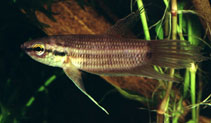
Épines dorsales (Total) : 2; Rayons mous dorsaux (Total) : 8 - 9; Épines anales: 2 - 4; Rayons mous anaux: 23 - 25. Distinguished from other members from Sumatra, Indonesia in the following characters: more anal fin rays (27 vs. 23-25); more dorsal fin rays than Betta cracens and Betta fusca (10-11 vs. 8-9); more subdorsal scales than Betta cracens and B. fusca (6 1/2-7 vs. 5 1/2-6); more lateral scales than B. fusca (31 vs. 29); fewer lateral scales than Betta cracens (31 vs. 32-33); fewer predorsal scales than Betta cracens, Betta fusca and Betta raja (17-19 vs. 20-24); greater head length than Betta pugnax, Betta cracens and Betta fusca (35-.5-36.5% SL vs. 27.5-35.2); smaller predorsal length than Betta fusca (62.7-66.3% SL vs. 68.5-70.2); greater preanal length than Betta cracens (47.8-50.9% SL vs. 42.0-46.1); greater body depth than Betta cracens (26.7-27.6% SL vs. 21.2-24.2); greater dorsal fin base length than Betta cracens (12.4-13.9% SL vs. 10.5-11.6); smaller anal fin base length than Betta cracens (50.4-52.0% SL vs. 53.4-55.7); greater orbital diameter than Betta cracens and Betta fusca (61-76% postorbital length vs. 47-58) (Ref. 56386).
Body shape (shape guide): fusiform / normal.
Facultative air-breathing (Ref. 126274); Found in forest swamp, peat swamp and hill stream.
Cycle de vie et comportement reproducteur
Maturité | Reproduction | Frai | Œufs | Fécondité | Larves
Kottelat, M. and P.K.L. Ng, 1994. Diagnoses of five new species of fighting fishes from Banka and Borneo (Teleostei: Belontiidae). Ichthyol. Explor. Freshwat. 5(1):65-78. (Ref. 12803)
Statut dans la liste rouge de l'IUCN (Ref. 130435: Version 2025-2 (Global))
Menacé (EN) (B1ab(iii)); Date assessed: 07 January 2019
Menace pour l'homme
Harmless
Utilisations par l'homme
Outils
Articles particuliers
Télécharger en XML
Sources Internet
Estimations basées sur des modèles
Indice de diversité phylogénétique (Réf.
82804): PD
50 = 0.5000 [Uniqueness, from 0.5 = low to 2.0 = high].
Bayesian length-weight: a=0.01000 (0.00374 - 0.02675), b=2.97 (2.74 - 3.20), in cm total length, based on LWR estimates for this (Sub)family-body shape (Ref.
93245).
Niveau trophique (Réf.
69278): 3.2 ±0.4 se; based on size and trophs of closest relatives
Résilience (Réf.
120179): Haut, temps minimum de doublement de population inférieur à 15 mois (Preliminary K or Fecundity.).
Vulnérabilité de la pêche (Ref.
59153): Low vulnerability (10 of 100).
🛈