Elasmobranquios (tiburones y rayas) (sharks and rays) >
Myliobatiformes (Stingrays) >
Dasyatidae (Stingrays) > Urogymninae
Etymology: Himantura: Greek, iman, imantos = thong, strap + Greek, oura = tail (Ref. 45335).
Eponymy: Dr Armand-Alfred-Antoine Krempf (d: 1879) was a French marine biologist, who first went to Vietnam (1903) as part of a scientific expedition to Hanoi. [...] (Ref. 128868), visit book page.
More on author: Chabanaud.
Entorno: milieu / zona climática / rango de profundidad / gama de distribución
Ecología
; agua dulce; salobre demersal. Tropical
Asia: Chao Phraya (Thailand) and Mekong basins.
Tamaño / Peso / Edad
Madurez: Lm ? range ? - ? cm
Max length : 40.0 cm WD macho / no sexado; (Ref. 12693)
Descripción breve
Claves de identificación | Morfología | Morfometría
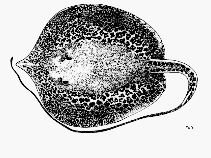
Plain ventral surface; reticulate pattern on dorsal surface; spiral valve with 11-14 turns.
Body shape (shape guide): other.
Inhabits estuaries and large rivers, often far upstream. Usually found over sandy substrates where it feeds on benthic invertebrates (Ref. 12693). Ovoviviparous (Ref. 50449).
Ciclo vital y comportamiento de apareamiento
Madurez | Reproducción | Puesta | Huevos | Fecundidad | Larva
Exhibit ovoviparity (aplacental viviparity), with embryos feeding initially on yolk, then receiving additional nourishment from the mother by indirect absorption of uterine fluid enriched with mucus, fat or protein through specialised structures (Ref. 50449). Distinct pairing with embrace (Ref. 205).
Rainboth, W.J., 1996. Fishes of the Cambodian Mekong. FAO species identification field guide for fishery purposes. FAO, Rome, 265 p. (Ref. 12693)
Situación en la Lista Roja de la UICN (Ref. 130435: Version 2025-2 (Global))
Amenaza para el ser humano
Usos humanos
Pesquerías: escaso valor comercial; Acuario: Comercial
Herramientas
Informes especiales
Descargar XML
Fuentes de Internet
Estimaciones basadas en modelos
Índice de diversidad filogenética (Referencia
82804): PD
50 = 0.5002 [Uniqueness, from 0.5 = low to 2.0 = high].
Bayesian length-weight: a=0.01023 (0.00482 - 0.02174), b=3.06 (2.86 - 3.26), in cm total length, based on LWR estimates for this (Sub)family-body shape (Ref.
93245).
Nivel trófico (Referencia
69278): 3.5 ±0.37 se; based on food items.
Resiliencia (Referencia
120179): Muy bajo, población duplicada en un tiempo mínimo superior a 14 años (Assuming Fec<10).
Vulnerabilidad pesquera (Ref.
59153): Very high vulnerability (90 of 100).
🛈