Milieu: milieu / Klimaatzone / Diepte / verspreidingsgebied
Ecologie
marien demersaal; diepte 1 - 800 m (Ref. 114953), usually 40 - 200 m (Ref. 114953). Subtropical
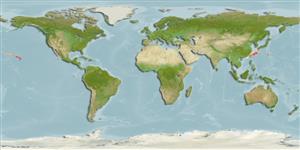
Eastern Atlantic: southern France to Angola, including the Mediterranean Sea. Indo-Pacific: widespread, from southern Africa to Hawaii.
Grootte / Gewicht / Leeftijd
Maturiteit: Lm ? range ? - ? cm
Max length : 260 cm WD mannelijk / geslacht onbekend; (Ref. 114953); max. gepubliceerd gewicht: 290.0 kg (Ref. 114953)
Korte beschrijving
Determinatiesleutels | Morfologie | Morfometrie
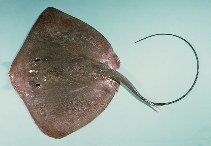
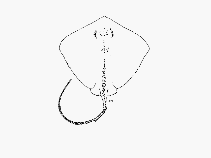
This species is huge, plain-coloured, with a disc broad and rhombic, has sharp thorns over its disc and tail in adults; it is moderately elongate, with gently tapering tail to caudal sting, a slender ventral tail fold and a minute dorsal fold; disc width ca. 1.2-1.3 times its length, very thick trunk; narrowly-rounded to angular pectoral-fin apex; short snout, broadly triangular with tip extended slightly and anterior margims weakly undulate; small eyes with orbit length and spiracle 2.1-2.5 in snout length, a broad interorbital space, up to 4.5 times orbit length in adults; broad mouth with 3-5 oral papillae, weak labial furrows, weakly convex lower jaw; very broadly skirt-shaped nasal curtain with its margin fringed; oblique oval nostrils; juveniles (< 60 cm WD) have smooth skin, sometimes with stellate thorns on mid-line of disc; snout and back with thorns more uptight and pointed, some on tail enlarged with broader bases; larger specimens have finely granular with denser cover of large thorns centrally, its tail beyond the sting is very thorny; broad tail, depressed at the base, its length twice disc width, tapering gently to sting, often with one caudal sting, its ventral fold is long, low with base about equal to predorsal length while dorsal fold is barely detectable; pelvic fins are rather small with angular apices. Colour of upper surface plain greyish brown or black; no distinct row of white pores on disc, but usually with irregular white flecks where skin is damaged; tail is dark dorsally before its sting, usually white ventrally; all surfaces are black beyond sting; ventral surface entirely white, black ventral fold (Ref. 114953).
Cross section: flattened.
Demersal or benthic on insular and continental shelves (Ref.58048, 58302); on on upper slopes to 800 m (Ref. 114953). Found on sand or mud bottoms, sometimes near coral reefs (Ref. 12951). Feeds on crabs, prawns and small bony fishes (Ref. 114953). Ovoviviparous (Ref. 50449). Males mature at ca. 100 cm WD, and females ca. 110 cm WD; pups born at ca. 35 cm WD; but these data measurements needs confirmation (Ref. 114953). Caught often by demersal tangle net and longline fisheries operating in shelf waters.Utilized for its meat, cartilage and thorny tail (58048).
Levenscyclus en paargedrag
Maturiteit | Voortplanting | Paaien | Eieren | Fecunditeit | Larven
Exhibit ovoviparity (aplacental viviparity), with embryos feeding initially on yolk, then receiving additional nourishment from the mother by indirect absorption of uterine fluid enriched with mucus, fat or protein through specialised structures (Ref. 50449). Distinct pairing with embrace (Ref. 205).
Last, P.R., W.T. White, M.R. de Carvalho, B. Séret, M.F.W. Stehmann and G.J.P. Naylor, 2016. Rays of the world. CSIRO Publishing, Comstock Publishing Associates. i-ix + 1-790. (Ref. 114953)
Status op de Rode Lijst van het IUCN (Ref. 130435: Version 2025-2 (Global))
Gevaar voor de mens
Traumatogenic (Ref. 6871)
Gebruik door de mens
Sportvis: ja
Tools
Speciale rapporten
Download XML
Internetbronnen
Schattingen op basis van modellen
Gewenste temperatuur (Ref.
123201): 15 - 21.9, mean 20.2 °C (based on 25 cells).
Fylogenetische diversiteitsindex (Ref.
82804): PD
50 = 0.6250 [Uniqueness, from 0.5 = low to 2.0 = high].
Bayesian length-weight: a=0.00447 (0.00189 - 0.01058), b=3.12 (2.92 - 3.32), in cm total length, based on LWR estimates for this (Sub)family-body shape (Ref.
93245).
Trofisch niveau (Ref.
69278): 3.9 ±0.5 se; based on size and trophs of closest relatives
Weerstandsvermogen (Ref.
120179): laag, minimale populatieverdubbelingstijd 4,5-14 jaar (Assuming fecundity<100).
Kwetsbaarheid van de visserij (Ref.
59153): Very high vulnerability (90 of 100).
🛈
Voedingsstoffen (Ref.
124155): Calcium = 6.36 [0.80, 118.23] mg/100g; Iron = 0.59 [0.05, 7.43] mg/100g; Protein = 21.3 [18.8, 23.8] %; Omega3 = 0.219 [0.073, 0.597] g/100g; Selenium = 47.8 [9.2, 241.6] μg/100g; VitaminA = 2.43 [0.21, 26.87] μg/100g; Zinc = 0.349 [0.020, 4.023] mg/100g (wet weight);