Classification / Noms
Noms communs | Synonymes | Catalog of Fishes(Genre, Espèce) | ITIS | CoL | WoRMS | Cloffa
>
Cypriniformes (Carps) >
Danionidae (Danios) > Rasborinae
Etymology: Rasbora: Rasbora, an Indian word for a fish, also used in Malay peninsula; paviana: Named for Auguste Pavie.
Eponymy: Auguste Jean-Marie Pavie (1847–1925) was a French colonial civil servant, explorer and diplomat who was instrumental in establishing French colonial control over Laos. [...] (Ref. 128868), visit book page.
Environnement : milieu / zone climatique / profondeur / gamme de distribution
Écologie
; eau douce benthopélagique. Tropical
Asia: Mekong, Chao Phraya and Meklong basins; also from northern Malay Peninsula.
Taille / Poids / Âge
Maturité: Lm ? range ? - ? cm
Max length : 12.0 cm SL mâle / non sexé; (Ref. 30857)
Description synthétique
Clés d'identification | Morphologie | Morphométrie
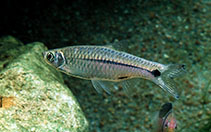
Has 1/2 4 scale rows between the dorsal-fin origin and the lateral line; a conspicuous, narrow, black longitudinal stripe along the sides, widening into a diamond-shaped blotch on the caudal peduncle (Ref. 27732). Scale margins outlined by reticulated dark pattern; black tips on caudal lobes present or absent; lateral line complete (Ref. 12693).
Body shape (shape guide): elongated.
Associated with clear, usually shallow and moderately flowing streams (Ref. 27732). Occur near the surface in small to medium-sized streams in upland areas. Individuals from high-gradient upland streams have a much darker stripe and often black tips on the caudal fin lobes. Feed probably on exogenous insects (Ref. 12693). Spawning sites are found in rivers and ponds (Ref. 33813). Mature adults probably breed during the rainy season. Not seen in the markets, but occasionally imported in the aquarium trade (Ref. 12693).
Cycle de vie et comportement reproducteur
Maturité | Reproduction | Frai | Œufs | Fécondité | Larves
Rainboth, W.J., 1996. Fishes of the Cambodian Mekong. FAO species identification field guide for fishery purposes. FAO, Rome, 265 p. (Ref. 12693)
Statut dans la liste rouge de l'IUCN (Ref. 130435: Version 2025-2 (Global))
Menace pour l'homme
Harmless
Utilisations par l'homme
Pêcheries: commercial; Aquarium: Commercial
Outils
Articles particuliers
Télécharger en XML
Sources Internet
Estimations basées sur des modèles
Indice de diversité phylogénétique (Réf.
82804): PD
50 = 0.5000 [Uniqueness, from 0.5 = low to 2.0 = high].
Bayesian length-weight: a=0.00851 (0.00532 - 0.01361), b=3.10 (2.97 - 3.23), in cm total length, based on LWR estimates for this species & Genus-body shape (Ref.
93245).
Niveau trophique (Réf.
69278): 3.2 ±0.40 se; based on food items.
Résilience (Réf.
120179): Haut, temps minimum de doublement de population inférieur à 15 mois (Preliminary K or Fecundity.).
Vulnérabilité de la pêche (Ref.
59153): Low vulnerability (10 of 100).
🛈