>
Esociformes (Pikes and mudminnows) >
Umbridae (Mudminnows)
Etymology: Umbra: Latin, umbra, -ae = shadow, in the sense of phantom; due to its quick movements (Ref. 45335).
More on author: DeKay.
Miljö: miljö / Klimatzon / djupintervall / distributionsområde
Ekologi
; sötvatten bottenlevande; pH range: 6.0 - 6.5; dH range: 3 - 8; ej vandrande (Ref. 5723). Temperate; 4°C - 23°C (Ref. 1672); 42°N - 30°N
North America: Atlantic and Gulf slopes from southeastern New York (including Long Island) to St.Johns River drainage in Florida and west to Aucilla River drainage in Florida and Georgia, USA (Ref. 5723). Introduced (but very localized) to central and western Europe (Ref. 59043).
Längd vid första mognad / Storlek / Vikt / Ålder
Könsmognad: Lm 3.7 range ? - ? cm
Max length : 13.7 cm TL hane/ej könsbestämd; (Ref. 88166); 15.0 cm TL (female)
Kort beskrivning
Bestämningsnycklar | Morfologi | Morfometri
Taggstrålar i ryggfenan (totalt) : 0; Mjukstrålar i ryggfenan (totalt) : 14 - 15; Taggstrålar i analfenan: 0; Mjukstrålar i analfenan: 8 - 11. Body robust, thick, little compressed; head bluntly conic; snout short, equal to diameter of eye; mouth moderate, jaws short, mandible protrudes slightly beyond tip of upper jaw, premaxillaries not protractile. Gill rakers short and numerous. Dorsal inserted near pectoral than caudal base; pelvic inserted just before origin of dorsal , rays of depressed fin reaching to about 3rd anal ray. Caudal fin rounded, with 18-20 rays (Ref. 2196).
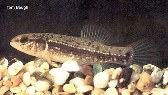
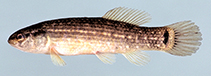
Pigmentation: yellowish green with 10-12 narrow lateral dark stripes; a dark stripe through eye; a black basicaudal bar; lower jaw pale; fins plain. Also Ref. 40476.
Body shape (shape guide): fusiform / normal; Cross section: compressed.
Facultative air-breathing (Ref. 126274); Adults inhabit quiet streams, sloughs, swamps and other wetlands over sand, mud and debris, often among dense vegetation. Juveniles also found among aquatic vegetation, often forming schools of 10-12 individuals (Ref. 39069). An introduced species in Europe which usually occurs in small isolated ponds and peat bogs (Ref. 59043). Oviparous, larvae remain in algal nest for about 6 days (Ref. 39067). Spawning takes place in April and May (Ref. 30578). Adults feed on insect larvae, worms, mollusks, crustaceans alevins. Experimental studies show that this species can tolerate acidic environment, particularly, at ph values ranging from 4.0 to 7.0 where no mortality or significant changes in blood plasma osmolarity and haematocrit was observed (Ref. 59260).
Page, L.M. and B.M. Burr, 1991. A field guide to freshwater fishes of North America north of Mexico. Houghton Mifflin Company, Boston. 432 p. (Ref. 5723)
Status på IUCN:s rödlista (Ref. 130435: Version 2025-2 (Global))
Hot mot människor
Harmless
Mänskliga användningsområden
Fiskeri: saknar intresse; Akvarium: Kommersiell
Verktyg
Särskilda rapporter
Ladda ner XML
Internet-källor
Uppskattningar baserade på modeller
Index för fylogenetisk mångfald (Ref.
82804): PD
50 = 0.6329 [Uniqueness, from 0.5 = low to 2.0 = high].
Bayesian length-weight: a=0.01000 (0.00501 - 0.01995), b=3.11 (2.93 - 3.29), in cm total length, based on LWR estimates for this species & (Sub)family-body (Ref.
93245).
Trofisk nivå (Ref.
69278): 3.3 ±0.39 se; based on food items.
Resiliens (Ref.
120179): Mellan, lägsta populationsfördubblingstid 1,4-4,4 år (tm=1.5-2; Ave. Fec=342).
Sårbarhet i fisket (Ref.
59153): Low vulnerability (10 of 100).
🛈