>
Cypriniformes (Carps) >
Cyprinidae (Minnows or carps) > Cyprininae
Etymology: Cosmochilus: Greek, kosmos, -ou = order, organization + Greek, cheilos = lip (Ref. 45335).
Eponymy: Dr François-Jules Harmand (1845–1921) was a French Navy Surgeon, and a naturalist and explorer in Indochina (1873–1877). [...] (Ref. 128868), visit book page.
More on author: Sauvage.
Ambiente: milieu / zona climatica / distribuzione batimetrica / gamma di distribuzione
Ecologia
; acqua dolce benthopelagico; potamodromo (Ref. 51243). Tropical
Asia: Chao Phraya and Mekong basins.
Dimensione / Peso / Età
Maturità: Lm ? range ? - ? cm
Max length : 100.0 cm TL maschio/sesso non determinato; (Ref. 12693); common length : 30.0 cm TL maschio/sesso non determinato; (Ref. 12693)
Breve descrizione
Chiavi di identificazione | Morfologia | Morfometria
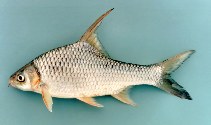
Vertebre: 35. With 5 branched anal fin rays; life color black rich pale blue, dorsal and caudal fins black-edged; in some specimens anal fin with black tip. Dorsal fin may also be black-tipped (Ref. 13216). Lips covered by large papillae; last simple dorsal ray osseous and serrated (Ref. 43281).
Body shape (shape guide): fusiform / normal.
Occurs from midwater to bottom depths in the middle and lower Mekong. Inhabits clear waters of the main channels during the dry season and moves to floodplains and riparian forests during the rainy season. Relatively common in the upland river habitat of the middle Mekong until water levels begin to rise. Dietary habits still unknown, but the subterminal mouth and papillate lips indicate that it probably roots around for food in fine-grained sediments (Ref. 12693). Found in the basin-wide mainstream of the lower Mekong (Ref. 36667).
Ciclo vitale e comportamento di accoppiamento
Maturità | Riproduzione | Deposizione | Uova | Fecondità | Larve
Rainboth, W.J., 1996. Fishes of the Cambodian Mekong. FAO species identification field guide for fishery purposes. FAO, Rome, 265 p. (Ref. 12693)
Stato della Lista Rossa IUCN (Ref. 130435: Version 2025-2 (Global))
Minaccia per l'uomo
Harmless
Usi umani
Pesca: commerciale
Strumenti
Rapporti speciali
Scarica XML
Fonti Internet
Stime basate su modelli
Indice di diversità filogenetica (Fonte Biblio.
82804): PD
50 = 0.5625 [Uniqueness, from 0.5 = low to 2.0 = high].
Bayesian length-weight: a=0.01122 (0.00526 - 0.02395), b=3.02 (2.84 - 3.20), in cm total length, based on LWR estimates for this (Sub)family-body shape (Ref.
93245).
Livello trofico (Fonte Biblio.
69278): 2.0 ±0.00 se; based on food items.
Resilienza (Fonte Biblio.
120179): Basso, tempo minimo di raddoppiamento della popolazione 4.5 - 14 anni (Assuming tm>4).
Vulnerabilità della pesca (Ref.
59153): High vulnerability (60 of 100).
🛈
Nutrienti (Ref.
124155): Calcium = 93 [54, 162] mg/100g; Iron = 1.32 [0.80, 2.04] mg/100g; Protein = 17.1 [16.3, 18.0] %; Omega3 = 0.359 [0.150, 0.858] g/100g; Selenium = 97.1 [38.5, 212.3] μg/100g; VitaminA = 38.9 [14.5, 105.5] μg/100g; Zinc = 1.99 [1.38, 2.89] mg/100g (wet weight);