การจำแนกประเภท / ชื่อ
ชื่อสามัญ | ชื่อพ้อง | Catalog of Fishes(สกุล, ชนิด) | ITIS | CoL | WoRMS | Cloffa
>
Cypriniformes (Carps) >
Cyprinidae (Minnows or carps) > Labeoninae
Etymology: Ceratogarra: Greek noun κzρας, -ατος (keras, keratos) meaning horn, and the ge genus name Garra; referring to the two ‘horns’ at the tip of the snout.
สิ่งแวดล้อม : สิ่งแวดล้อม / เขตภูมิอากาศ / ระดับความลึก / ระยะการกระจายสินค้า
นิเวศวิทยา
; น้ำจืด กลุ่มสัตว์หน้าดิน,กลุ่มสัตว์พื้นท้องน้ำ. Tropical; 20°C - 25°C (Ref. 13614)
Southeast Asia: middle and lower Mekong, Chao Phraya and Mae Khlong drainages, and the northern part of the Malay Peninsula.
ขนาด / น้ำหนัก / อายุ
วัยเจริญพันธุ์: Lm ? range ? - ? cm
Max length : 24.0 cm TL เพศผู้/กระเทย; (Ref. 118477)
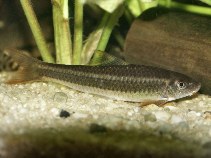
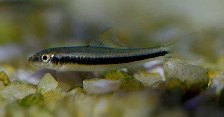
This species is distinguished from by the following set of characters: with a pair of large conical tubercles at the tip of the snout, directed laterally; top and side of the snout (between the tip and the eye) with numerous tubercles, all conical, of various sizes; with a broad, contrasted dark brown to black midlateral stripe on a pale brown background and whitish to yellow lower half of flank; a red to black marginal or submarginal band along the upper and lower edges of the caudal fin; a single pair of barbels (maxillary); the pulvinus of the gular disc thin, flat, covering the posterior edge of the torus; no groove between the pulvinus and the labrum; lateral extremities of the torus continuous with the labrum and the labella; the labrum connected to the rostral cap by the labella (partly folded under the labrum); the torus, labella and labrum (sometimes also the anterior edge of the pulvinus) are entirely covered by small papillae; no subtoral fold and proboscis (Ref. 128869).
Cross section: compressed.
Inhabits rocky bottoms in swiftly moving water of small and medium-sized streams. Feeds on periphyton, phytoplankton and some insects (Ref. 12693). usually abundant; the adults live in loose groups of 4-10 individuals while juveniles 3.0-4.0 cm SL may form loose schools of tens of individuals (Ref. 128869). Not fished commercially, but occasionally seen in the aquarium trade (Ref 12693).
วงจรชีวิตและพฤติกรรมการผสมพันธุ์
วัยเจริญพันธุ์ | การสืบพันธุ์ | การวางไข่ | เซลสืบพันธ์ของเพศเมีย(ไข่) | ความดกของไข่ | ตัวอ่อน
Kottelat, M., 2020. Ceratogarra, a genus name for Garra cambodgiensis and G. fasciacauda and comments on the oral and gular soft anatomy in labeonine fishes (Teleostei: Cyprinidae). Raffles Bulletin of Zoology Suppl. 35:156-178. (Ref. 128869)
สถานะบัญชีแดงของ IUCN (Ref. 130435: Version 2025-2 (Global))
ภัยคุกคามต่อมนุษย์
Harmless
การใช้ของมนุษย์
การประมง: การค้า; สถานที่แสดงสัตว์และพืชน้ำ: การค้า
เครื่องมือ
รายงานพิเศษ
ดาวน์โหลด XML
แหล่งที่มาจากอินเตอร์เน็ต
การประมาณค่าตามแบบจำลอง
ดัชนีความหลากหลายทางวิวัฒนาการ (อ้างอิง
82804): PD
50 = 0.6250 [Uniqueness, from 0.5 = low to 2.0 = high].
Bayesian length-weight: a=0.00891 (0.00461 - 0.01723), b=3.02 (2.86 - 3.18), in cm total length, based on LWR estimates for this species & (Sub)family-body (Ref.
93245).
ระดับชั้นอาหาร (อ้างอิง
69278): 2.4 ±0.21 se; based on food items.
ความสามารถในการกลับคืนสู่ปกติ (อ้างอิง
120179): ขนาดกลาง, เวลาต่ำสุดที่จะทำให้ประชากรเพิ่มขึ้นเป็น 2 เท่าใช้เวลา 1.4 - 4.4 ปี (Preliminary K or Fecundity.).
ความเสี่ยงต่อการตกปลา (Ref.
59153): Low vulnerability (14 of 100).
🛈