>
Blenniiformes (Blennies) >
Blenniidae (Combtooth blennies) > Salariinae
Etymology: Blenniella: Diminutive of blennius, Greek,blenios = mucus (Ref. 45335).
More on author: Günther.
पर्यावरण: पर्यावरण / जलवायु क्षेत्र / गहराई सीमा / वितरण सीमा
पारिस्थितिकी
समुद्री प्रवाल-भित्ति संयुक्त; गहराई सीमा 0 - 3 m (Ref. 90102). Tropical; 16°N - 24°S
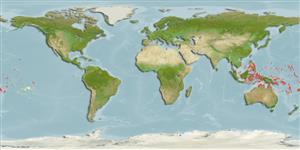
Pacific Ocean: southern Japan to the Moluccas, east to Mariana Islands, Tonga, and Tuamoto Archipelago; Tawara, Kiribati and Howland Island. Replaced by Blenniella cyanostigma in the Indian Ocean (Ref. 37816).
आकार / वज़न / आयु
परिपक्व अवधि: Lm ? range ? - ? cm
Max length : 8.2 cm SL पुल्लिंग / अलिंग; (Ref. 9962); 6.8 cm SL (female)
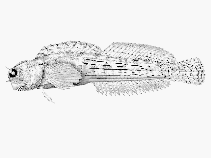
पृष्ठीय रीढ़ (सम्पूर्ण) : 12 - 14; पृष्ठीय सौफट रेज़ (सम्पूर्ण) : 19 - 22; गुदा कांटा: 2 - 3; ऐनल सौफट रेज़: 20 - 23; जानवरों की रीड़ का जोड़: 37 - 40. Diagnosis: Dorsal fin XII-XIV, 19-22, notched between spinous and segmented-ray portions; anal fin II-III, 20-23 (rarely 23); pectoral rays 12-15 (usually 14); pelvic fin I, 3; caudal fin procurrent rays 10-16, segmented rays 13. Vertebrae 10-12 + 26-29. Last pleural rib on 11-13th vertebrae. Orbital cirrus simple filamentous; nasal cirri short and simple to palmate with 2-7 branches; nape without cirri. Lateral line, continuous anterodorsally below dorsal spines from 6-7th to 10th, disconnected posteroventrally up to below dorsal spine 9-13th. Mandibular pores 3-7 Lips margin entire. Occipital crest present, higher in males (Ref. 9962). Body depth at anal-fin origin 5.8-7.3 in SL. Male crest yellow; body greyish, shading ventrally to white, with 9 brown or olive vertical bars on side, and some horizontal streaks on middle of body (Ref. 90102). Females have numerous longitudinal pinstripes on their sides and black specks on their fins while males have dark patches and small blue spots on their sides (Ref. 37816).
Body shape (shape guide): elongated.
Adults inhabit exposed shallow shores (0-3 m) and often found in tidepools (Ref. 90102). Oviparous. Eggs are demersal and adhesive (Ref. 205), and are attached to the substrate via a filamentous, adhesive pad or pedestal (Ref. 94114). Larvae are planktonic, often found in shallow, coastal waters (Ref. 94114).
जीवन चक्र और संभोग व्यवहार
परिपक्व अवधि | पुनरुत्पत्ति | मछलीऔ का अंडे देना | अंडे | उपजाऊपन | लार्वा
Distinct pairing (Ref. 205).
Springer, V.G. and J.T. Williams, 1994. The Indo-West Pacific blenniid fish genus Istiblennius reappraised: a revision of Istiblennius, Blenniella, and Paralticus, new genus. Smithson. Contrib. Zool. 565:1-193. (Ref. 9962)
आईयूसीएन रेड लिस्ट स्थिति (Ref. 130435: Version 2025-2 (Global))
मनुष्यों के लिए ख़तरा
Harmless
मानव उपयोग
साधन
विशेष रिपोर्ट
XML डाउनलोड करें
इंटरनेट स्रोत
मॉडल पर आधारित अनुमान
पसंदीदा तापमान (संदर्भ
123201): 26.7 - 29.4, mean 28.7 °C (based on 908 cells).
जातिवृति विविधता सूचकांक (संदर्भ
82804): PD
50 = 0.5020 [Uniqueness, from 0.5 = low to 2.0 = high].
Bayesian length-weight: a=0.00776 (0.00354 - 0.01702), b=3.00 (2.81 - 3.19), in cm total length, based on LWR estimates for this (Sub)family-body shape (Ref.
93245).
ट्रॉफिक स्तर (संदर्भ
69278): 2.8 ±0.3 se; based on size and trophs of closest relatives
लौटाव (संदर्भ
120179): ऊंचा, न्यूनतम जनसंख्या दुगनी समय अवलागत 15 महीने। (Preliminary K or Fecundity.).
मछली पकड़ने की भेद्यता (Ref.
59153): Low vulnerability (10 of 100).
🛈
पोषक तत्व (Ref.
124155): Calcium = 191 [89, 351] mg/100g; Iron = 0.902 [0.484, 1.651] mg/100g; Protein = 17.9 [16.6, 19.1] %; Omega3 = 0.0717 [, ] g/100g; Selenium = 16.5 [7.3, 39.6] μg/100g; VitaminA = 133 [31, 574] μg/100g; Zinc = 2.93 [1.85, 4.49] mg/100g (wet weight);