>
Aulopiformes (Grinners) >
Synodontidae (Lizardfishes) > Synodontinae
Etymology: Synodus: Greek, syn, symphysis = grown together + Greek, odous = teeth (Ref. 45335).
More on author: Linnaeus.
Ambiente: milieu / zona climática / intervalo de profundidade / gama de distribuição
Ecologia
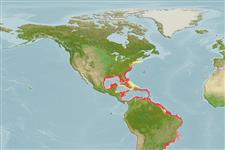
marinhas; estuarina associadas(os) a recifes; intervalo de profundidade 0 - 200 m (Ref. 9710). Tropical; 25°C - 35°C (Ref. 39158); 43°N - 29°S, 98°W - 34°W
Western Atlantic: Massachusetts, USA and northern Gulf of Mexico to Brazil.
Comprimento na primeira maturidade / Tamanho / Peso / Idade
Maturidade: Lm 19.0 range ? - ? cm
Max length : 53.8 cm TL macho/indeterminado; (Ref. 102462); common length : 30.0 cm TL macho/indeterminado; (Ref. 5217); peso máx. Publicado: 900.00 g (Ref. 40637)
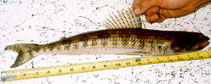
Espinhos dorsais (total) : 0; Raios dorsais moles (total) : 10 - 13; Espinhos anais: 0; Raios anais moles: 11 - 13; Vértebras: 56 - 62. Body elongate, cylindrical; head depressed, broader than deep, slightly rugose above, interorbital space concave; snout triangular, pointed, projecting beyond tip of mandible, typically longer than diameter of eye in specimens larger than 20.0 cm SL; 6-7 oblique rows of scales present on cheeks; top of head naked. Mouth very large, gape extends well past eye; upper jaw projects slightly, premaxillaries form entire margin of upper jaw; large, sharp depressible teeth present on upper jaw, tongue and lower pharyngeals. Scales small (except for patch of large elongate scales present below pectoral base and above pelvic base), lateral line well marked, not keeled. Dorsal fin origin equidistant form center of eye and adipose fin, anterior rays not reaching past tips of posterior rays with fin depressed; anal fin base longer than or equal to dorsal base, origin equidistant form end of dorsal base and base of caudal rays; caudal fin not or barely reaching origin of pelvic fin; pelvic fins inserted closer to vent than to snout tip; inner ray of pelvic much longer than outer ray (Ref. 13608); adipose fin base no longer than diameter of pupil. Anterior nares with prominent dermal flap. Gill rakers rudimentary. Branchiostegals: 12-16 (Ref. 4639).
Pigmentation: Color variable with both locality and immediate background; dorsum brownish or olivaceous and with overall greenish cast; mid-lateral line with about 8 obscure blotches, variable in occurrence and intensity, fading wit growth; head brownish with light vermiculations on top and sides, pale yellow below; belly white, silvery white, or yellowish, sometimes with brownish punctuations; pectorals dusky, yellowish, or light green; adipose with dark spot posteriorly.
Body shape (shape guide): elongated; Cross section: circular.
Adults are found on both shallow and deep sand flats among grass (Ref. 12342, 39154, 39155), inshore in saltwater creeks, rivers, bays, sounds (Ref. 39156), and deep channels within lagoons (Ref. 39155). Probably more dense over mud than shell or calcareous bottom (Ref. 39157). Also found in open ocean over continental shelf (Ref. 4639). A solitary (Ref. 26340) voracious predator that lurks in shallow bays and shore waters; burrows in bottom sediments. Juveniles are pelagic, and readily collected from open ocean, usually near land in vicinity of or in shallow water (Ref. 4639). Mostly piscivorous, also includes shrimps, crabs and cephalopodes (Ref. 93252). Oviparous, newly hatched larvae are found near the surface at depths from 27 to 46 m (Ref. 39159). Salinity range 4.0-60.0 ppt (may include juveniles), more abundant above 10.0 ppt and 30.0 ppt (Ref. 39158, 39162, 39050). Commonly caught by anglers but considered a nuisance.
Robins, C.R. and G.C. Ray, 1986. A field guide to Atlantic coast fishes of North America. Houghton Mifflin Company, Boston, U.S.A. 354 p. (Ref. 7251)
Categoria na Lista Vermelha da IUCN (Ref. 130435: Version 2025-2 (Global))
Ameaça para o homem
Harmless
Utilização humana
Pescarias: pescarias de subsistência; peixe desportivo: sim
Ferramentas
Relatórios especiais
Descarregue XML
Fontes da internet
Estimativas baseadas em modelos
Temperatura preferida (Ref.
123201): 18.9 - 27.5, mean 24.8 °C (based on 317 cells).
Índice de diversidade filogenética (Ref.
82804): PD
50 = 0.5000 [Uniqueness, from 0.5 = low to 2.0 = high].
Bayesian length-weight: a=0.00447 (0.00377 - 0.00529), b=3.14 (3.10 - 3.18), in cm total length, based on LWR estimates for this species (Ref.
93245).
Nível Trófico (Ref.
69278): 4.5 ±0.0 se; based on diet studies.
Resiliência (Ref.
120179): Médio, tempo mínimo de duplicação da população 1,4 - 4,4 anos (Preliminary K or Fecundity.).
Vulnerabilidade da pesca (Ref.
59153): Moderate vulnerability (42 of 100).
🛈
Nutrientes (Ref.
124155): Calcium = 36 [12, 71] mg/100g; Iron = 0.426 [0.147, 0.932] mg/100g; Protein = 16.2 [13.3, 18.5] %; Omega3 = 0.0722 [, ] g/100g; Selenium = 41.4 [15.3, 89.5] μg/100g; VitaminA = 88.1 [23.2, 337.6] μg/100g; Zinc = 0.882 [0.514, 1.339] mg/100g (wet weight); based on
nutrient studies.