Elasmobranchi (squali e razze) (sharks and rays) >
Squaliformes (Sleeper and dogfish sharks) >
Dalatiidae (Sleeper sharks)
Etymology: Squaliolus: Diminutive of squalus (L.), a sea-fish, usually applied to sharks, referring to small size of S. laticaudus (See ETYFish); aliae: In honor of the Teng’s wife Huang A-li, for her “cordial help and constant encouragement” [originally spelled alii; since name honors a woman, aliae reflects the correct gender] (See ETYFish).
Eponymy: Huang A-li is the name of Teng’s wife. He named the shark, which was first caught inTaiwanese waters, after her “…for her continuous encouragement and assistance over the past 20-some years”. (Ref. 128868), visit book page.
Ambiente: milieu / zona climatica / distribuzione batimetrica / gamma di distribuzione
Ecologia
marino batipelagico; distribuzione batimetrica 200 - 2000 m (Ref. 6871). Deep-water
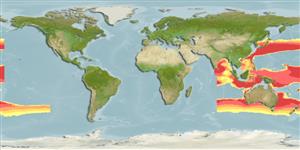
Western Pacific: Japan to Australia (off northwestern Australia and New South Wales).
Lunghezza alla prima maturità / Dimensione / Peso / Età
Maturità: Lm ?, range 15 - ? cm
Max length : 22.0 cm TL maschio/sesso non determinato; (Ref. 6871)
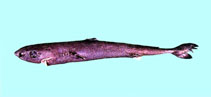
Spine dorsali (totale) : 1; Spine anali: 0. The smalleye pygmy shark, Squaliolus aliae, is a very small dogfish (about 22cm) characterized by its small eye, with diameter about 46-70% of interorbital width, and with upper margin angular and chevron-shaped; upper lip with a pair of prominent lateral papillae (rarely indistinct) (Ref. 31367, 6871).Colour: dark brown to black, fin margins pale (Ref. 6871). Squaliolus are the only sharks with a fin spine on its first dorsal fin (spine sometimes concealed by skin) but not on its second dorsal fin; second dorsal fin long-based and low, about twice the length of the first dorsal fin base; first dorsal-fin base closer to pectoral fins than to pelvic fins; and caudal fin nearly symmetrical, with subterminal notch present (Ref. 247, 6871).
Body shape (shape guide): elongated.
Possibly the smallest living shark (Ref. 6871). Found near continental and island land masses (Ref. 31367). Feeds mainly on cephalopods and small midwater bony fishes (Ref. 6871). Probably makes diurnal vertical migrations from within 200 m of the surface at night down to about 2,000 m during the day (Ref. 6871). Ovoviviparous (Ref. 6871).
Ciclo vitale e comportamento di accoppiamento
Maturità | Riproduzione | Deposizione | Uova | Fecondità | Larve
Distinct pairing with embrace (Ref. 205). Ovoviviparous but litter size unknown (Ref. 6871). Males mature at 15 cm (Ref. 31367).
Last, P.R. and J.D. Stevens, 1994. Sharks and rays of Australia. CSIRO, Australia. 513 p. (Ref. 6871)
Stato della Lista Rossa IUCN (Ref. 130435: Version 2025-2 (Global))
Minaccia per l'uomo
Harmless
Usi umani
Pesca: di nessun interesse
Strumenti
Rapporti speciali
Scarica XML
Fonti Internet
Stime basate su modelli
Temperatura preferita (Fonte Biblio.
123201): 4.6 - 10.1, mean 6.5 °C (based on 559 cells).
Indice di diversità filogenetica (Fonte Biblio.
82804): PD
50 = 0.7510 [Uniqueness, from 0.5 = low to 2.0 = high].
Bayesian length-weight: a=0.00309 (0.00143 - 0.00669), b=3.14 (2.94 - 3.34), in cm total length, based on LWR estimates for this (Sub)family-body shape (Ref.
93245).
Livello trofico (Fonte Biblio.
69278): 4.4 ±0.57 se; based on food items.
Resilienza (Fonte Biblio.
120179): Basso, tempo minimo di raddoppiamento della popolazione 4.5 - 14 anni (Fec assumed to be <100).
Vulnerabilità della pesca (Ref.
59153): Low vulnerability (12 of 100).
🛈