>
Blenniiformes (Blennies) >
Blenniidae (Combtooth blennies) > Salariinae
Etymology: Ecsenius: Greek, exenios, -os, -on = uncontrolled, immoderate.
Eponymy: Dr Gerald Robert ‘Gerry’ Allen (d: 1942) is an American-born Australian ichthyologist. [...] (Ref. 128868), visit book page.
Milieu: milieu / Klimaatzone / Diepte / verspreidingsgebied
Ecologie
marien rifbewoner; diepte 1 - 35 m (Ref. 5296). Tropical
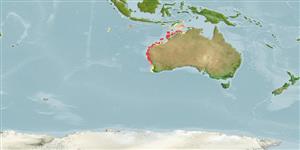
Eastern Indian Ocean: known only from Scott Reef and Clerke and Mermaid reefs, Rowley Shoals, Western Australia.
Grootte / Gewicht / Leeftijd
Maturiteit: Lm ? range ? - ? cm
Max length : 3.4 cm SL mannelijk / geslacht onbekend; (Ref. 5296)
Korte beschrijving
Determinatiesleutels | Morfologie | Morfometrie
Dorsale stekels (totaal) : 12; Dorsale zachte stralen (totaal) : 13 - 14; Anale stekels: 2; Anale zachte stralen: 14 - 16. Dorsal fin XII,13-14 (typically 13), deeply notched between spinous- and segmented-ray sides. Anal fin II,14-16 (typically 15). Vertebrae 10 + 21-22 (typically 22). Dentary incisor teeth 41
to 50 (rarely more than 47; includes anterior canine teeth, very similar in appearance to incisors); posterior canines one on each side. Lateral line lacking vertical pairs of pores, terminating posteriorly at point between vertical from interspace between bases of 10th and 11th dorsal-fin spines and vertical at base of 12th dorsal-fin spine (usually ending at or anterior to base of 11th spine). With short cirrus on posterior rim of anterior nostril, absent on anterior rim. With an intensely dark banded pattern on the body with occasional spot-like intensifications of pigment within the bands; with a large, dark spot on the pectoral-fin base and in the axil.
Body shape (shape guide): elongated; Cross section: oval.
Common in lagoon and outer reef areas. Oviparous. Eggs are demersal and adhesive (Ref. 205), and are attached to the substrate via a filamentous, adhesive pad or pedestal (Ref. 94114). Larvae are planktonic, often found in shallow, coastal waters (Ref. 94114).
Levenscyclus en paargedrag
Maturiteit | Voortplanting | Paaien | Eieren | Fecunditeit | Larven
Oviparous, distinct pairing (Ref. 205).
Springer, V.G., 1988. The Indo-Pacific blenniid fish genus Ecsenius. Smithson. Contrib. Zool. (465):134 p. (Ref. 5296)
Status op de Rode Lijst van het IUCN (Ref. 130435: Version 2025-2 (Global))
Gevaar voor de mens
Harmless
Gebruik door de mens
Tools
Speciale rapporten
Download XML
Internetbronnen
Schattingen op basis van modellen
Gewenste temperatuur (Ref.
123201): 18.4 - 28.7, mean 27.8 °C (based on 102 cells).
Fylogenetische diversiteitsindex (Ref.
82804): PD
50 = 0.5000 [Uniqueness, from 0.5 = low to 2.0 = high].
Bayesian length-weight: a=0.00776 (0.00354 - 0.01702), b=3.00 (2.81 - 3.19), in cm total length, based on LWR estimates for this (Sub)family-body shape (Ref.
93245).
Trofisch niveau (Ref.
69278): 2.0 ±0.00 se; based on food items.
Weerstandsvermogen (Ref.
120179): Hoog, minimale populatieverdubbelingstijd minder dan 15 maanden (Preliminary K or Fecundity.).
Kwetsbaarheid van de visserij (Ref.
59153): Low vulnerability (10 of 100).
🛈
Voedingsstoffen (Ref.
124155): Calcium = 332 [152, 710] mg/100g; Iron = 1.32 [0.71, 2.55] mg/100g; Protein = 17.6 [16.2, 18.8] %; Omega3 = 0.103 [0.047, 0.220] g/100g; Selenium = 30.9 [11.6, 80.1] μg/100g; VitaminA = 123 [26, 560] μg/100g; Zinc = 4.18 [2.52, 6.43] mg/100g (wet weight);