Klassifizierung / Names
Namen | Synonyme | Catalog of Fishes(Gattung, Arten) | ITIS | CoL | WoRMS | Cloffa
>
Siluriformes (Catfishes) >
Bagridae (Bagrid catfishes)
Etymology: Hemibagrus: Greek, hemi = the half + Mozarabic, bagre, Greek, pagros = a fish, Dentex sp. (Ref. 45335).
Eponymy: Dr Jan van der Hoeven (1801–1868) was a Dutch zoologist and physician who took degrees in physics (1822) and medicine (1824) at Leiden University, then practised as a physician (1824–1826). [...] (Ref. 128868), visit book page.
More on author: Bleeker.
Umwelt: Milieu / Klimazone / Tiefenbereich / Verbreitungsgebiet
Ökologie
; süßwasser; brackwasser demersal. Tropical
Asia: Java, Sumatra, Borneo and Malay Peninsula.
Größe / Gewicht / Alter
Geschlechtsreife: Lm ? range ? - ? cm
Max length : 35.0 cm SL Männchen/unbestimmt; (Ref. 37837)
Kurzbeschreibung
Bestimmungsschlüssel | Morphologie | Morphometrie
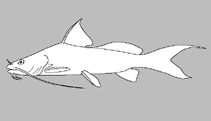
Easily distinguished from H. nemurus by the shape and coloration of the caudal, adipose, dorsal and anal fins, the shape of the snout, occipital process and body. Has broad and conspicuous black margin all around the caudal fin (versus the fin has at most a dark narrow posterior margin), the fin is more deeply notched, the two lobes are very long and narrow, the lower lobe is about 3.5-4.0 times longer than the median rays (versus the lobes are broader and shorter, the lower one being about 2.0-2.5 times longer than the median rays), and the upper lobe regularly tapers (versus the upper lobe is somewhat rounded posteriorly, with the upper simple principal rays produced into a filament). The adipose fin is shorter, its base is included about 1.5-2.0 times into the distance between the posterior extremity of the dorsal base and the adipose origin (versus about 1.0-1.5 times in H. nemurus). Dorsal fin has a more slender appearance; membranes between the rays are narrower so that the fin has a more triangular appearance. The last branched ray is about 2-3 times in the length of the first branched rays (versus about 1.5-2.0 times) and the dorsal spine is about 2.5 times in the predorsal length (versus about 3 times) and about equal to distance between head and dorsal base (versus shorter). The anal fin is triangular (versus rounded); the snout is more protruding and most of the tooth band on the upper jaw is exposed (versus only part of it is exposed in H. nemurus); the occipital process is either visible or at least can be felt through the skin and muscles to the dorsal fin origin. The posterior part is deeply buried in the muscles and cannot be felt); and the female genital papilla is relatively longer (reaching anal origin, versus not reaching) (Ref. 37837).
Appears to be found only in the lower reaches and estuaries of large rivers (Ref. 40801).
Lebenszyklus und Paarungsverhalten
Geschlechtsreife | Fortpflanzung | Ablaichen | Eier | Fruchtbarkeit | Larven
Kottelat, M. and K.K.P. Lim, 1995. Hemibagrus hoevenii, a valid species of sundaic catfish (Teleostei: Bagridae). Malay. Nat. J. 49:41-47. (Ref. 37837)
IUCN Rote Liste Status (Ref. 130435: Version 2025-2 (Global))
Bedrohung für Menschen
Harmless
Nutzung durch Menschen
Tools
Zusatzinformationen
Download XML
Internet Quellen
Schätzungen auf der Grundlage von Modellen
Phylogenetischer Diversitätsindex (Ref.
82804): PD
50 = 0.5000 [Uniqueness, from 0.5 = low to 2.0 = high].
Bayesian length-weight: a=0.00871 (0.00415 - 0.01826), b=2.93 (2.76 - 3.10), in cm total length, based on LWR estimates for this (Sub)family-body shape (Ref.
93245).
Trophische Ebene (Ref.
69278): 3.5 ±0.6 se; based on size and trophs of closest relatives
Widerstandsfähigkeit (Ref.
120179): mittel, Verdopplung der Population dauert 1,4 - 4,4 Jahre. (Preliminary K or Fecundity.).
Anfälligkeit der Fischerei (Ref.
59153): Low to moderate vulnerability (33 of 100).
🛈