>
Anguilliformes (Eels and morays) >
Muraenidae (Moray eels) > Uropterygiinae
Etymology: Uropterygius: Greek, oura = tail + Greek pterygion = little wing. Fin (Ref. 45335).
More on author: Regan.
Environnement : milieu / zone climatique / profondeur / gamme de distribution
Écologie
marin récifal; profondeur 0 - 10 m (Ref. 90102). Tropical
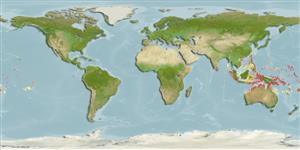
Indo-Pacific: Indonesia, Papua New Guinea. Solomons, Palau, Tokelau and Kapingamarangi in Micronesia (Ref. 37816).
Taille / Poids / Âge
Maturité: Lm ? range ? - ? cm
Max length : 53.0 cm TL mâle / non sexé; (Ref. 37816)
Épines dorsales (Total) : 0; Rayons mous dorsaux (Total) : 0; Épines anales: 0; Rayons mous anaux: 0; Vertèbres: 127. TL to 53 cm.
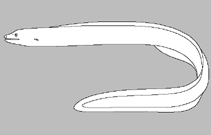
Body shape (shape guide): eel-like; Cross section: oval.
Adults inhabit shallow lagoon reefs in areas of sand, coralline algae and coral heads (Ref. 37816). Possibly are protogynous hermaphrodites (Ref. 32169).
Cycle de vie et comportement reproducteur
Maturité | Reproduction | Frai | Œufs | Fécondité | Larves
Protogyny unconfirmed (Ref. 84746).
Kailola, P.J., 1987. The fishes of Papua New Guinea. A revised and annotated checklist. Vol. 1. Myxinidae to Synbranchidae. Research Bulletin No. 41. Department of Fisheries and Marine Resources, Port Moresby, Papua New Guinea. 194 p. (Ref. 6993)
Statut dans la liste rouge de l'IUCN (Ref. 130435: Version 2025-2 (Global))
Menace pour l'homme
Harmless
Utilisations par l'homme
Pêcheries: d'intérêt potentiel
Outils
Articles particuliers
Télécharger en XML
Sources Internet
Estimations basées sur des modèles
Température préférée (Réf.
123201): 28 - 29.3, mean 28.8 °C (based on 1049 cells).
Indice de diversité phylogénétique (Réf.
82804): PD
50 = 0.5000 [Uniqueness, from 0.5 = low to 2.0 = high].
Bayesian length-weight: a=0.00071 (0.00034 - 0.00148), b=3.12 (2.93 - 3.31), in cm total length, based on LWR estimates for this (Sub)family-body shape (Ref.
93245).
Niveau trophique (Réf.
69278): 3.5 ±0.6 se; based on size and trophs of closest relatives
Résilience (Réf.
120179): Milieu, temps minimum de doublement de population : 1,4 à 4,4 années (Preliminary K or Fecundity.).
Vulnérabilité de la pêche (Ref.
59153): Moderate vulnerability (41 of 100).
🛈