>
Cypriniformes (Carps) >
Xenocyprididae (East Asian minnows)
Etymology: Hypophthalmichthys: Greek, hypo = under + Greek, ophthalmos = eye + Greek, ichthys = fish (Ref. 45335); nobilis: nobilis, meaning noble (Ref. 10294).
More on author: Richardson.
Ambiente: milieu / zona climatica / distribuzione batimetrica / gamma di distribuzione
Ecologia
; acqua dolce; salmastro benthopelagico; potamodromo (Ref. 126106); distribuzione batimetrica 0 - ? m (Ref. 59043). Temperate; 1°C - 38°C (Ref. 120904); 34°N - 21°N, 101°E - 123°E (Ref. 121042)
Asia: China. Introduced to numerous countries and has achieved a near global distribution. However, its breeding requirements are very specialized and stocks are maintained by artificial reproduction or continuous importation. Several countries report adverse ecological impact after introduction (Ref. 1739). Often confused with Hypophthalmichthys molitrix (Ref. 59043).
Lunghezza alla prima maturità / Dimensione / Peso / Età
Maturità: Lm 64.2, range 55 - 70 cm
Max length : 146 cm SL maschio/sesso non determinato; (Ref. 59043); common length : 60.0 cm TL maschio/sesso non determinato; (Ref. 2059); peso massimo pubblicato: 40.0 kg (Ref. 59043); Età massima riportata: 20 anni (Ref. 59043)
Breve descrizione
Chiavi di identificazione | Morfologia | Morfometria
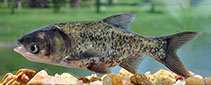
Spine dorsali (totale) : 3; Raggi dorsali molli (totale) : 7; Spine anali: 1 - 3; Raggi anali molli: 12 - 14. Body with numerous scattered small black blotches. Keels extend from pelvic base to anus. Barbels absent. Posterior margin of last simple dorsal ray not serrated. Branched anal rays 13-14.5 (Ref. 13274). Differs from Hypophthalmichthys molitrix by having scaled keel from pelvic to anal, 240-300 long gill rakes, head length 27-35% SL, dark overall coloration, flank with dark, large, very irregularly shaped blotches, fin bases and inferior parts of head and belly yellowish (Ref. 59043).
Body shape (shape guide): fusiform / normal; Cross section: oval.
Adults occur in rivers with marked water-level fluctuations, overwinters in middle and lower stretches. As bottom feeders (Ref. 6459), they feed in shallow (0.5-1.5 m deep) and warm (over 24°C) backwaters, lakes and flooded areas with slow current on zooplankton and algae (Ref. 59043) throughout its life under natural conditions (Ref. 120904). Breeding ocurrs in very deep, very turbid and warm water above 18°C (usually 22-30°C), with high current (1.1-1.9 m/s) and high oxygen concentrations. Stocked to large rivers and almost all still water bodies as lakes and ponds. In aquaculture, adults can survive brackish water (up to 7 ppt) when released into estuaries and coastal lakes. They undertake long distance upriver migration at start of a rapid flood and water-level increase (in April-July depending on locality). Spawning occurs in upper water layer or even at surface during floods. Spawning ceases if conditions change and resumes again when water level increases. After spawning, adults migrate for foraging habitats, Larvae drift downstream and settle in floodplain lakes, shallow shores and backwaters with little or no current. During autumn-winter, when temperature drops to 10°C, juveniles and adults form separate large schools and migrate downstream to deeper places in main course of river to overwinter (Ref. 59043). Marketed fresh and frozen.
Produces up to 100,000 eggs (Ref. 2059). Eggs are yellowish, transparent, and hatch after about 2 days at temperatures around 25°C while drifting downstream in the deep open-water layer (Ref. 59043).
Kottelat, M., 2001. Freshwater fishes of northern Vietnam. A preliminary check-list of the fishes known or expected to occur in northern Vietnam with comments on systematics and nomenclature. Environment and Social Development Unit, East Asia and Pacific Region. The World Bank. 123 p. (Ref. 44416)
Stato della Lista Rossa IUCN (Ref. 130435: Version 2025-2 (Global))
Minaccia per l'uomo
Potential pest
Usi umani
Pesca: elevato interesse commerciale; Acquacoltura: commerciale; Pesce da pesca sportiva: si; Acquario: Acquari pubblici
Strumenti
Rapporti speciali
Scarica XML
Fonti Internet
Stime basate su modelli
Indice di diversità filogenetica (Fonte Biblio.
82804): PD
50 = 0.6250 [Uniqueness, from 0.5 = low to 2.0 = high].
Bayesian length-weight: a=0.00977 (0.00842 - 0.01135), b=3.10 (3.06 - 3.14), in cm total length, based on LWR estimates for this species (Ref.
93245).
Livello trofico (Fonte Biblio.
69278): 2.8 ±0.33 se; based on food items.
Resilienza (Fonte Biblio.
120179): Medio, tempo minimo di raddoppiamento della popolazione 1.4 - 4.4 anni (tm=3-5; tmax=20; K=0.15-0.27; Fec=50,000-1 million).
Vulnerabilità della pesca (Ref.
59153): High vulnerability (64 of 100).
🛈
Nutrienti (Ref.
124155): Calcium = 15.1 [5.5, 42.3] mg/100g; Iron = 0.422 [0.206, 0.879] mg/100g; Protein = 17.1 [16.0, 18.3] %; Omega3 = 0.543 [0.287, 1.037] g/100g; Selenium = 14.3 [7.2, 28.2] μg/100g; VitaminA = 10.6 [2.8, 41.9] μg/100g; Zinc = 0.271 [0.152, 0.501] mg/100g (wet weight); based on
nutrient studies.