Clasificación / Nombres
Nombres comunes | Sinónimos | Catalog of Fishes(Género, Especie) | ITIS | CoL | WoRMS | Cloffa
>
Pleuronectiformes (Flatfishes) >
Soleidae (Soles)
Etymology: Aseraggodes: Greek, aggos, -eos, -ous = vessel, uterus, carapace of a crab + Greek, aseros, -a, -on = to remove the appetite (Ref. 45335).
Eponymy: John Roxborough Norman (1898–1944) was an English ichthyologist who started his working life as a bank clerk. [...] (Ref. 128868), visit book page.
More on author: Chabanaud.
Entorno: milieu / zona climática / rango de profundidad / gama de distribución
Ecología
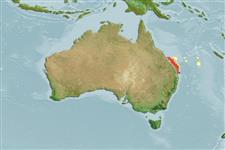
marino demersal; rango de profundidad 15 - 27 m (Ref. 57560). Tropical; 22°S - 27°S (Ref. 57560)
Western Central Pacific: Australia.
Tamaño / Peso / Edad
Madurez: Lm ? range ? - ? cm
Max length : 13.2 cm TL macho / no sexado; (Ref. 56490)
Descripción breve
Claves de identificación | Morfología | Morfometría
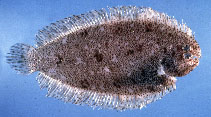
Radios blandos dorsales (total) : 64 - 71; Radios blandos anales: 50 - 52; Vértebra: 35 - 36. Diagnosis. Dorsal rays 64-71; anal rays 50-52; dorsal and anal rays unbranched; pelvic rays 5; caudal rays 18, 14 branched. Lateral-line scales 68-73 (counted to origin of dorsoanterior branch on head). Only tips of cteni projecting beyond posterior edge of scales, with at most 8 cteni tips posteriorly on body, fewer anteriorly. Eyes separated by 3 rows of scales at narrowest place, with an additional row medially and anteriorly on each eye. Vertebrae 35-36 (usually 35); dorsal pterygiophores anterior to fourth neural spine 10-11. Body depth 2.3-2.55 in SL; head length (HL) 4.4-4.8 in SL; snout length 2.3-2.5 in HL. Scales anteriorly on head replaced by slender cirri, progressively longer, those at ventral edge of head and front of snout up to three-fourths eye diameter in length. Lateral line aligned with dorsal edge of upper eye, ending with a dorsoanterior branch of 7-9 pored scales, straight branch of 4-6 scales, and ventral branch of 7-9 scales; no pores detected beneath scales on ocular side of body. Eye diameter 5.0-6.5 in HL; upper eye overlapping anterior one-half to three-fourths of lower eye; narrowest vertical interorbital space 8.2-9.0 in HL; upper end of gill opening at level of ventral fleshy edge of lower eye: tubular anterior nostril broad, not reaching fleshy base of lower eye when laid back. Caudal peduncle absent, depth at base of caudal fin 1.55-1.8 in HL; caudal fin rounded, its length 4.1-4.5 in SL. Longest dorsal ray 1.35-1.5 in HL; blind side of dorsal and anal rays with a lengthwise thin membranous ridge, broad at base and narrowing as it extends up to three-fourths ray length anteriorly, progressively shorter and narrower posteriorly; edge of membrane on anterior rays of blind side of dorsal fin with cirri; pelvic fins 1.9-2.05 in HL, the tip of longest ray extending to base of second or third anal ray; ocular-side pelvic fin distinctly anterior and larger than fin of blind side; both fins broadly joined by membrane from their fifth rays and jointly to the large genital papilla about one-half length above its base. Color in alcohol light brown, densely dotted with black and short black scale edges; scattered roundish pale spots smaller than eye variously present, some free of black dots; median fins with black dots, but fewer than on body; one specimen with a few large dark blotches on lateral line and on either side of lateral line (Ref. 57560).
Body shape (shape guide): short and / or deep.
Ciclo vital y comportamiento de apareamiento
Madurez | Reproducción | Puesta | Huevos | Fecundidad | Larva
Kailola, P.J., 1991. The fishes of Papua New Guinea: a revised and annotated checklist. Vol. III. Gobiidae to Molidae. Research Bulletin No. 41, Research Section, Dept. of Fisheries and Marine Resources, Papua New Guinea. 153 p. (Ref. 6771)
Situación en la Lista Roja de la UICN (Ref. 130435: Version 2025-2 (Global))
Amenaza para el ser humano
Harmless
Usos humanos
Herramientas
Informes especiales
Descargar XML
Fuentes de Internet
Estimaciones basadas en modelos
Temperatura preferida (Referencia
123201): 24.3 - 24.8, mean 24.6 °C (based on 10 cells).
Índice de diversidad filogenética (Referencia
82804): PD
50 = 0.5000 [Uniqueness, from 0.5 = low to 2.0 = high].
Bayesian length-weight: a=0.00955 (0.00454 - 0.02011), b=3.07 (2.90 - 3.24), in cm total length, based on LWR estimates for this (Sub)family-body shape (Ref.
93245).
Nivel trófico (Referencia
69278): 3.6 ±0.5 se; based on size and trophs of closest relatives
Resiliencia (Referencia
120179): Alto, población duplicada en un tiempo mínimo inferior a 15 meses (Preliminary K or Fecundity.).
Vulnerabilidad pesquera (Ref.
59153): Low vulnerability (10 of 100).
🛈