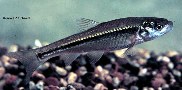
Klassifizierung / Names
Namen | Synonyme | Catalog of Fishes(Gattung, Arten) | ITIS | CoL | WoRMS | Cloffa
>
Cypriniformes (Carps) >
Leuciscidae (Minnows) > Pogonichthyinae
Etymology: Hybognathus: Greek, ybos, -e, -on = curved + Greek, gnathos = jaw; with bulging jaw (Ref. 45335).
Eponymy: Thomas Leroy Hankinson (1876–1935) was an American ichthyologist, herpetologist and ornithologist. [...] (Ref. 128868), visit book page.
More on author: Hubbs.
Umwelt: Milieu / Klimazone / Tiefenbereich / Verbreitungsgebiet
Ökologie
; süßwasser demersal. Temperate; 58°N - 37°N
North America: St. Lawrence River and Lake Champlain drainages in Quebec, Canada and in Vermont, USA; across Great Lakes, Hudson Bay and Missouri-upper Mississippi River basins of southern Canada and northern USA south to Missouri and Colorado; Mackenzie River system (Arctic basin) in Alberta, Canada; Fraser River system (Pacific Slope) in British Columbia, Canada.
Länge bei der ersten Reifung / Größe / Gewicht / Alter
Geschlechtsreife: Lm 5.7 range ? - ? cm
Max length : 9.7 cm TL Männchen/unbestimmt; (Ref. 86798); common length : 7.6 cm TL Männchen/unbestimmt; (Ref. 12193)
Adults occur in cool pools of sluggish, clear creeks and small rivers, usually over sand or gravel; more abundant in cool acid waters of silt-bottomed bog ponds (Ref. 1998). They probably feed on phytoplankton and other algae, zooplankton, and aquatic insects (Ref. 1998). Oviparous, open substratum spawners (Ref. 205, 52559). Probably spawn in May or June over silty bottoms of calm waters (Ref. 1998). Predators may include brook trout, kingfishers, and mergansers (Ref. 1998). Migratory behaviour is undetermined (Ref. 126106).
Lebenszyklus und Paarungsverhalten
Geschlechtsreife | Fortpflanzung | Ablaichen | Eier | Fruchtbarkeit | Larven
Page, L.M. and B.M. Burr, 2011. A field guide to freshwater fishes of North America north of Mexico. Boston : Houghton Mifflin Harcourt, 663p. (Ref. 86798)
IUCN Rote Liste Status (Ref. 130435: Version 2025-2 (Global))
Bedrohung für Menschen
Harmless
Nutzung durch Menschen
Köder: usually
Tools
Zusatzinformationen
Download XML
Internet Quellen
Schätzungen auf der Grundlage von Modellen
Phylogenetischer Diversitätsindex (Ref.
82804): PD
50 = 0.5039 [Uniqueness, from 0.5 = low to 2.0 = high].
Bayesian length-weight: a=0.00537 (0.00266 - 0.01086), b=3.10 (2.92 - 3.28), in cm total length, based on LWR estimates for this (Sub)family-body shape (Ref.
93245).
Trophische Ebene (Ref.
69278): 3.1 ±0.40 se; based on food items.
Widerstandsfähigkeit (Ref.
120179): mittel, Verdopplung der Population dauert 1,4 - 4,4 Jahre. (tm=1-2).
Anfälligkeit der Fischerei (Ref.
59153): Low vulnerability (10 of 100).
🛈