>
Blenniiformes (Blennies) >
Chaenopsidae (Pike-, tube- and flagblennies)
Etymology: Emblemariopsis: Latin, emblema = insertion, inlaid work, raised ornament + Greek, opsis = appearance (Ref. 45335).
Eponymy: Dr John ‘Jack’ Ernest Randall Jr. [...] (Ref. 128868), visit book page.
Environnement : milieu / zone climatique / profondeur / gamme de distribution
Écologie
marin récifal; profondeur 3 - 9 m (Ref. 125603). Tropical
Western Central Atlantic: Venezuela.
Taille / Poids / Âge
Maturité: Lm ? range ? - ? cm
Max length : 3.2 cm SL mâle / non sexé; (Ref. 125603)
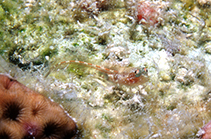
Épines dorsales (Total) : 20 - 21; Rayons mous dorsaux (Total) : 10 - 13; Épines anales: 2; Rayons mous anaux: 22 - 24. This species (without an orbital cirrus and with a red banner) is distinguished by the following characters: TP territorial males found in holes with a black head and blackened anterior dorsal fin with a distal red band over a narrow white band and a thin white or blue margin, the red band extending posteriorly to 7th-10th spinous membrane, and forming a straight line or curved down when fully erected in displaying TP, the first dorsal-fin spine relatively short, when adpressed reaching to 5th-6th spine base, about half HL, the subsequent spines progressively slightly longer (Ref. 125603).
Dark-shaded and pale TP with a similar red-banded dorsal fin, but a wider white band, and dark membrane only on first one or two membranes; with a row of large dark spots along body just below base of spinous dorsal fin, absence of rows of dark spots along spinous-dorsal-fin membranes or along lateral midline or mid-way between lateral midline and base of dorsal fin; a large black patch around the anus; head mostly unmarked except for a pale or bluish reticulated pattern under the lower jaw; a dark or reddish oblique band across its iris; no opercular bands or lines (Ref. 125603).
IP with short first several dorsal-fin spines, the first spine reaching to base of 4th-5th spine base when adpressed, the fourth spine shortest and midfin spines longest, forming a slightly notched dorsal-fin profile, the first few membranes with dark reticulated bands or lines and a reddish edge (even in juveniles); head and body are mostly unmarked except for dark or reddish oblique band across iris, a row of reddish or dark spots along body just below the base of spinous dorsal fin, a large black patch around anus, a wide internal reddish or dark band along sides of the vertebral column, and a dark distal band along anterior of anal fin. Colouration: live colors include orange, pink and yellow; cranial pattern a simple pale band 2 and 4; no IP head spots or markings near the pectoral-fin base; the IP fish and pale TP individuals live in groups on reef (vs. no apparent grouping behavior in any congeners) (Ref. 125603).
Cross section: oval.
Occurs in shallow waters,on sand and rocks. Form relatively tight groups perched over coral
heads, often as separate groupings of IP females and pale TP fish, while territorial black males are found alone in burrows, usually challenged by passing pale TP individuals (Ref. 125603). Feeds on zooplankton.
Cycle de vie et comportement reproducteur
Maturité | Reproduction | Frai | Œufs | Fécondité | Larves
Victor, B.C., 2020. Review of the glass blennies (Teleostei: Chaenopsidae: Emblemariopsis) with two new species from the Caribbean Sea. J. Ocean Sci. Found. 37:1-122. (Ref. 125603)
Statut dans la liste rouge de l'IUCN (Ref. 130435: Version 2025-2 (Global))
Menace pour l'homme
Harmless
Utilisations par l'homme
Outils
Articles particuliers
Télécharger en XML
Sources Internet
Estimations basées sur des modèles
Indice de diversité phylogénétique (Réf.
82804): PD
50 = 0.5001 [Uniqueness, from 0.5 = low to 2.0 = high].
Bayesian length-weight: a=0.00525 (0.00224 - 0.01232), b=3.07 (2.86 - 3.28), in cm total length, based on LWR estimates for this (Sub)family-body shape (Ref.
93245).
Niveau trophique (Réf.
69278): 3.4 ±0.45 se; based on food items.
Vulnérabilité de la pêche (Ref.
59153): Low vulnerability (10 of 100).
🛈