>
Siluriformes (Catfishes) >
Ictaluridae (North American freshwater catfishes)
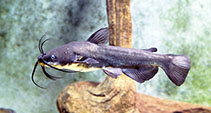
Etymology: Ameiurus: Greek, a = without + Greek, meiouros, -os, -on = without tail (Ref. 45335); melas: melas meaning black (Ref. 1998).
More on author: Rafinesque.
Entorno: milieu / zona climática / rango de profundidad / gama de distribución
Ecología
; agua dulce demersal; pH range: 6.5 - 8.0; dH range: 4 - 25; potamodromo (Ref. 126106); rango de profundidad 10 - ? m. Temperate; 8°C - 30°C (Ref. 2059); 52°N - 26°N
North America: Great Lakes to northern Mexico. Confusion over the taxonomic status of this species together with Ameiurus nebulosus resulted in more doubts as to which of the two is present in some countries. In Europe it forms dense stunted populations which makes it unpopular. Several countries report adverse ecological impact after introduction (Ref. 1739). In Europe, self-sustaining populations recorded from Ebro and Tagus drainages (Iberian Peninsula), most drainages of France, locally in Italy, the Netherlands and Germany; distribution could be wider (Ref. 59043)
Tamaño / Peso / Edad
Madurez: Lm ? range ? - ? cm
Max length : 66.0 cm TL macho / no sexado; (Ref. 40637); common length : 26.6 cm TL macho / no sexado; (Ref. 12193); peso máximo publicado: 3.6 kg (Ref. 4699); edad máxima reportada: 10 años (Ref. 12193)
Adults inhabit pools, backwaters, and sluggish current over soft substrates in creeks and small to large rivers; impoundments, oxbows, and ponds. Nocturnal feeders, Young consume immature insects, leeches, and crustaceans while adults also feed on clams, snails, plant material, and fishes (Ref. 1998, 9669, 10294). Edible (Ref. 1998). They are susceptible of being caught, where they are abundant, with baited lines intended for other species. Is considered a nuisance (Ref. 30578). Often misidentified as A. nebulosus (Ref. 59043).
Ciclo vital y comportamiento de apareamiento
Madurez | Reproducción | Puesta | Huevos | Fecundidad | Larva
The female prepares the nest by clearing debris, gravel and silt found on the bottom. Before spawning, the pair engages in butting and in sliding its barbels over the body of the other. The female releases her eggs after the male wraps his caudal fin around the head of the female. The pair can spawn up to five times in an hour. In between spawning, the female fans the eggs. Both male and female guards and fans the eggs.
Page, L.M. and B.M. Burr, 1991. A field guide to freshwater fishes of North America north of Mexico. Houghton Mifflin Company, Boston. 432 p. (Ref. 5723)
Situación en la Lista Roja de la UICN (Ref. 130435: Version 2025-2 (Global))
Amenaza para el ser humano
Potential pest
Usos humanos
Pesquerías: comercial; Acuicultura: comercial; pesca deportiva: si
Herramientas
Informes especiales
Descargar XML
Fuentes de Internet
Estimaciones basadas en modelos
Índice de diversidad filogenética (Referencia
82804): PD
50 = 0.5078 [Uniqueness, from 0.5 = low to 2.0 = high].
Bayesian length-weight: a=0.00871 (0.00676 - 0.01121), b=3.12 (3.05 - 3.19), in cm total length, based on LWR estimates for this species (Ref.
93245).
Nivel trófico (Referencia
69278): 3.8 ±0.4 se; based on diet studies.
Resiliencia (Referencia
120179): Medio, población duplicada en un tiempo mínimo de 1.4-4.4 años (tmax=10; Assuming tm=3).
Vulnerabilidad pesquera (Ref.
59153): Moderate to high vulnerability (46 of 100).
🛈
Nutrientes (Ref.
124155): Calcium = 26.2 [14.2, 56.7] mg/100g; Iron = 0.454 [0.256, 0.749] mg/100g; Protein = 17.2 [15.2, 19.0] %; Omega3 = 1.23 [0.46, 3.30] g/100g; Selenium = 17 [7, 43] μg/100g; VitaminA = 20.3 [6.4, 62.9] μg/100g; Zinc = 0.612 [0.409, 0.891] mg/100g (wet weight);