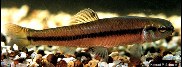
Klassifizierung / Names
Namen | Synonyme | Catalog of Fishes(Gattung, Arten) | ITIS | CoL | WoRMS | Cloffa
>
Cypriniformes (Carps) >
Leuciscidae (Minnows) > Pogonichthyinae
Etymology: Pimephales: Greek, pimeles, -es = fat + Greek, phales = whale; if the root is Greek, phales, -etos = penis (Ref. 45335); notatus: notatus, meaning spotted or distinctly marked (Ref. 10294).
More on author: Rafinesque.
Umwelt: Milieu / Klimazone / Tiefenbereich / Verbreitungsgebiet
Ökologie
; süßwasser demersal; potamodrom (Ref. 126106). Temperate; 0°C - 33°C (Ref. 35682); 50°N - 31°N
North America: Great Lakes, Hudson Bay (Red River) and Mississippi River basins from southern Quebec to southern Manitoba, Canada and south to Louisiana, USA; Atlantic Slope from St. Lawrence River in Quebec to Roanoke River in USA; Gulf Slope from Mobile Bay drainage in Alabama to Mississippi River, USA.
Größe / Gewicht / Alter
Geschlechtsreife: Lm ? range ? - ? cm
Max length : 11.0 cm TL Männchen/unbestimmt; (Ref. 5723); common length : 6.5 cm TL Männchen/unbestimmt; (Ref. 12193); max. veröff. Alter: 5 Jahre (Ref. 12193)
Kurzbeschreibung
Bestimmungsschlüssel | Morphologie | Morphometrie
Adults occur almost anywhere in its range but most common in clear rocky streams (Ref. 3814, 10294); also inhabit large rivers, reservoirs and glacial lakes to the north. Feed on algae, detritus, entomostraca, and immature insects, especially midge larvae and pupae (Ref. 10294).
Lebenszyklus und Paarungsverhalten
Geschlechtsreife | Fortpflanzung | Ablaichen | Eier | Fruchtbarkeit | Larven
A hole nester.
Robins, C.R., R.M. Bailey, C.E. Bond, J.R. Brooker, E.A. Lachner, R.N. Lea and W.B. Scott, 1991. Common and scientific names of fishes from the United States and Canada. Am. Fish. Soc. Spec. Publ. (20):183 p. (Ref. 3814)
IUCN Rote Liste Status (Ref. 130435: Version 2025-2 (Global))
Bedrohung für Menschen
Harmless
Nutzung durch Menschen
Tools
Zusatzinformationen
Download XML
Internet Quellen
Schätzungen auf der Grundlage von Modellen
Phylogenetischer Diversitätsindex (Ref.
82804): PD
50 = 0.5625 [Uniqueness, from 0.5 = low to 2.0 = high].
Bayesian length-weight: a=0.00759 (0.00470 - 0.01224), b=3.21 (3.07 - 3.35), in cm total length, based on LWR estimates for this species & (Sub)family-body (Ref.
93245).
Trophische Ebene (Ref.
69278): 2.7 ±0.1 se; based on diet studies.
Widerstandsfähigkeit (Ref.
120179): mittel, Verdopplung der Population dauert 1,4 - 4,4 Jahre. (tmax=5).
Anfälligkeit der Fischerei (Ref.
59153): Low vulnerability (10 of 100).
🛈