Ambiente: milieu / zona climatica / distribuzione batimetrica / gamma di distribuzione
Ecologia
; acqua dolce demersale; potamodromo (Ref. 126106); distribuzione batimetrica 5 - ? m (Ref. 27732). Subtropical; 5°C - 25°C (Ref. 2060); 53°N - 27°S
Asia: Native to Siberia (Tugur and Amur drainages), Sakhalin, Korea, Japan, China south to northern Vietnam. Europe: Introduced in several localities in Rhine (France Ref. 132967, Germany) and Ticino (Italy, north of Milano) drainages, Aral Sea basin, North America, Australia and Hawaii.
This species proved successful in the aquarium fish trade and has also been introduced to other countries (Ref. 1739). At least one country reports adverse ecological impact after introduction.
Dimensione / Peso / Età
Maturità: Lm ? range ? - ? cm
Max length : 28.0 cm SL maschio/sesso non determinato; (Ref. 59043); common length : 15.0 cm TL maschio/sesso non determinato; (Ref. 12193)
Breve descrizione
Chiavi di identificazione | Morfologia | Morfometria
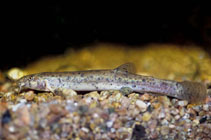
Dorsal view shows the male with larger pectoral fins and the female with fuller abdomen (Ref. 44091). Body is mottled with darker greenish-gray to dark brown markings, against a yellow-brown to brown color; conspicuous adipose crests along the ventral and dorsal mid-lines of the caudal peduncle; 10 barbels; suborbital spine hidden in the skin (Ref. 27732).
Body shape (shape guide): elongated.
Facultative air-breathing (Ref. 126274); Adults occur in rivers, lakes and ponds. Also in swamps and ricefields (Ref. 27732, 119549). They prefer muddy bottoms, where they hide in the muck and leaf litter with only their heads sticking outi, They can also be found under mats of honohono (Commelina diffusa and California grass (Brachiara nuatica). They feed on worms, small crustaceans, insects, insect larvae, and other small aquatic organisms (Ref. 44091).
Male wraps his body around the female and stimulates her to release a cloud of eggs, which the male simultaneously fertilizes (Ref. 44091).
Talwar, P.K. and A.G. Jhingran, 1991. Inland fishes of India and adjacent countries. vol 1. A.A. Balkema, Rotterdam. i-liv + 1-541, 1 map (Ref. 4832)
Stato della Lista Rossa IUCN (Ref. 130435: Version 2025-2 (Global))
Minaccia per l'uomo
Potential pest (Ref. 8923)
Usi umani
Pesca: commerciale; Acquacoltura: commerciale; Acquario: Commerciale; esca: occasionally
Strumenti
Rapporti speciali
Scarica XML
Fonti Internet
Stime basate su modelli
Indice di diversità filogenetica (Fonte Biblio.
82804): PD
50 = 0.5020 [Uniqueness, from 0.5 = low to 2.0 = high].
Bayesian length-weight: a=0.00457 (0.00391 - 0.00534), b=3.09 (3.05 - 3.13), in cm total length, based on LWR estimates for this species (Ref.
93245).
Livello trofico (Fonte Biblio.
69278): 3.1 ±0.4 se; based on diet studies.
Resilienza (Fonte Biblio.
120179): Medio, tempo minimo di raddoppiamento della popolazione 1.4 - 4.4 anni (Fec=2000 eggs).
Vulnerabilità della pesca (Ref.
59153): Low to moderate vulnerability (31 of 100).
🛈