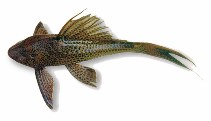
Taxonomic Remarks
Neotype designation of Acipenser plecostomus in Boeseman 1968 (RMNH 182400) may be invalid if the smallest specimen in NRM LP 32 is part of the type series; for more details on synonymy of Hypostomus plecostomus see Boeseman (1968:32) and Isbrücker (1980:30). Mitochondrial D-loop sequences used in a molecular phylogeny of Hypostomus and related genera by Montoya-Burgos and Weber (in press, fig. 2; EMBL/GenBank AJ318351).
Environnement : milieu / zone climatique / profondeur / gamme de distribution
Écologie
; eau douce; saumâtre démersal; pH range: 6.2 - 8.2; dH range: ? - 28. Tropical; 20°C - 28°C (Ref. 2060); 12°N - 25°S, 60°W - 51°W
South America: Guianas (coastal region from the Oyapock River basin to the Essequibo River basin). Identity of reported introduced species to several Asian countries for the aquarium trade need further confirmation.
Taille / Poids / Âge
Maturité: Lm ? range ? - ? cm
Max length : 25.0 cm SL mâle / non sexé; (Ref. 90186); common length : 28.0 cm TL mâle / non sexé; (Ref. 12193)
This species is distinguished by the following characters: differs from species of the H. cochliodon group (H. macushi and H. taphorni in the Guianas) by having viliform teeth (vs. large spoon-shaped teeth); differs from other Guianese species of Hypostomus by having teeth bearing a short roughly rounded crown, with lateral cusp about half the length of the main cusp (vs. an elongated crown, with a small lateral cusp in coppenamensis, corantijni, crassicauda, gymnorhynchus,nematopterus, watwata), or sometimes with an enlarged lateral cusp (observed in H. gymnorhynchus from upper Maroni River Basin only, H. micromaculatus and H. paucimaculatus); differs from long-crown toothed species except H. watwata by the presence of a preanal plate (vs. absence); differs from H. watwata in having an azygous plate which is sometimes divided into two to three secondary platelets, bordering the posterior part of the supraoccipital and directly contacting the pterotic-supracleithrum, laterally bordered by two plates that contact only the pterotic-supracleithrum (vs. an azygous plate, often divided anteriorly in small secondary platelets, not connecting the pterotic-supracleithrum, and with two lateral areas divided in multiple platelets, 4-13, bordering the postero-lateral part of the supraoccipital and the posterior part of the pterotic-supracleithrum (Ref. 90186).
Cross section: oval.
Facultative air-breathing (Ref. 126274); This species inhabits the lower part of rivers still under tide influence, and characterized by a quiet flowing water and muddy substrate, and swamps (Ref. 90186). Feeds on algae and small crustaceans. Is cultured in ponds in Singapore and Hong Kong for the aquarium trade, where it is very popular (Ref. 2060).
Cycle de vie et comportement reproducteur
Maturité | Reproduction | Frai | Œufs | Fécondité | Larves
Deposits eggs on smooth rocks. Eggs are guarded by one or both parents. May deposit eggs in depressions (Ref. 2060).
Weber, C., R. Covain and S. Fisch-Muller, 2012. Identity of Hypostomus plecostomus (Linnaeus, 1758), with an overview of Hypostomus species from the Guianas (Teleostei: Siluriformes: Loricariidae). Cybium 36(1):195-227. (Ref. 90186)
Statut dans la liste rouge de l'IUCN (Ref. 130435: Version 2025-2 (Global))
Menace pour l'homme
Harmless
Utilisations par l'homme
Pêcheries: commercial; Aquarium: hautement commercial
Outils
Articles particuliers
Télécharger en XML
Sources Internet
Estimations basées sur des modèles
Indice de diversité phylogénétique (Réf.
82804): PD
50 = 0.5000 [Uniqueness, from 0.5 = low to 2.0 = high].
Bayesian length-weight: a=0.01905 (0.01591 - 0.02282), b=2.95 (2.92 - 2.98), in cm total length, based on LWR estimates for this species (Ref.
93245).
Niveau trophique (Réf.
69278): 2.5 ±0.26 se; based on food items.
Résilience (Réf.
120179): Milieu, temps minimum de doublement de population : 1,4 à 4,4 années (Assuming tmax>3; Fec = 3,000).
Vulnérabilité de la pêche (Ref.
59153): Low vulnerability (20 of 100).
🛈