Umwelt: Milieu / Klimazone / Tiefenbereich / Verbreitungsgebiet
Ökologie
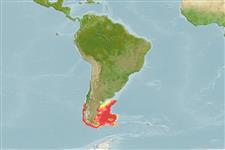
seewasser demersal; ozeanodrom (Ref. 51243); tiefenbereich 30 - 1000 m. Subtropical; 40°S - 57°S, 76°W - 55°W (Ref. 1371)
Southeast Pacific and Southwest Atlantic: Patagonian region of Chile and Argentina, including the Falkland Islands and the Strait of Magellan.
Größe / Gewicht / Alter
Geschlechtsreife: Lm ? range ? - ? cm
Max length : 50.0 cm TL Männchen/unbestimmt; (Ref. 1371)
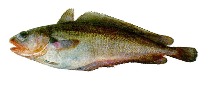
Rückenflossenstacheln (insgesamt) : 0; Rückenflossenweichstrahlen (insgesamt) : 59 - 70; Afterflossenstacheln: 0; Afterflossenweichstrahlen: 54 - 63; Wirbelzahl: 52 - 54. A small variably shaped patch of teeth on head of vomer. Pectoral fin extending beyond anal fin origin. Ventral light organ present. Color uniformly brown; fins dark-edged (Ref. 1371). Caudal fin rounded (Ref. 27363).
Body shape (shape guide): elongated; Cross section: oval.
Highest catches at 235 m. Females attain larger sizes than males. Larger individuals of both sexes move into deeper water. Utilized mainly for fishmeal; can be fried, microwaved and baked (Ref. 9988).
Lebenszyklus und Paarungsverhalten
Geschlechtsreife | Fortpflanzung | Ablaichen | Eier | Fruchtbarkeit | Larven
Cohen, D.M., T. Inada, T. Iwamoto and N. Scialabba, 1990. FAO species catalogue. Vol. 10. Gadiform fishes of the world (Order Gadiformes). An annotated and illustrated catalogue of cods, hakes, grenadiers and other gadiform fishes known to date. FAO Fish. Synop. 125(10). Rome: FAO. 442 p. (Ref. 1371)
IUCN Rote Liste Status (Ref. 130435: Version 2025-2 (Global))
Bedrohung für Menschen
Harmless
Nutzung durch Menschen
Fischereien: weniger kommerziell
Tools
Zusatzinformationen
Download XML
Internet Quellen
Schätzungen auf der Grundlage von Modellen
Bevorzugte Temperatur (Ref.
123201): 3.3 - 7.7, mean 5.7 °C (based on 115 cells).
Phylogenetischer Diversitätsindex (Ref.
82804): PD
50 = 1.0000 [Uniqueness, from 0.5 = low to 2.0 = high].
Bayesian length-weight: a=0.00468 (0.00276 - 0.00793), b=3.11 (2.95 - 3.27), in cm total length, based on LWR estimates for this species & (Sub)family-body (Ref.
93245).
Trophische Ebene (Ref.
69278): 4.4 ±0.3 se; based on diet studies.
Widerstandsfähigkeit (Ref.
120179): mittel, Verdopplung der Population dauert 1,4 - 4,4 Jahre. (Assuming tm=2-3).
Prior r = 0.57, 95% CL = 0.37 - 0.85, Based on 1 data-limited stock assessment.
Anfälligkeit der Fischerei (Ref.
59153): Moderate vulnerability (40 of 100).
🛈
Klimaanfälligkeit (Ref.
125649): Moderate to high vulnerability (54 of 100).
🛈
Nährstoffe (Ref.
124155): Calcium = 58 [29, 126] mg/100g; Iron = 0.945 [0.508, 1.791] mg/100g; Protein = 17.6 [15.2, 19.6] %; Omega3 = 0.26 [0.13, 0.50] g/100g; Selenium = 44.8 [20.4, 95.5] μg/100g; VitaminA = 23.2 [6.5, 84.7] μg/100g; Zinc = 0.592 [0.395, 0.902] mg/100g (wet weight); based on
nutrient studies.