>
Percopsiformes (Trout-perches, pirate perches and cavefishes) >
Amblyopsidae (Cavefishes)
Etymology: agassizii: Named after the great naturalist Louis Agassiz (Ref. 10294).
Eponymy: Stephen Alfred Forbes (1844–1930) was an entomologist, self-taught naturalist, farmer and ecologist. [...] Jean Louis Rudolphe Agassiz (1807–1873) was a Swiss-American geologist, glaciologist and zoologist whose speciality was ichthyology. [...] (Ref. 128868), visit book page.
Environnement : milieu / zone climatique / profondeur / gamme de distribution
Écologie
; eau douce démersal; non migrateur (Ref. 126106). Temperate; 39°N - 35°N
North America: portions of Tennessee, Kentucky, Illinois and Missouri, U.S.A.
Taille / Poids / Âge
Maturité: Lm ? range ? - ? cm
Max length : 9.0 cm TL mâle / non sexé; (Ref. 10294); common length : 5.3 cm TL mâle / non sexé; (Ref. 12193); âge max. reporté: 3.00 années (Ref. 10294)
Description synthétique
Clés d'identification | Morphologie | Morphométrie
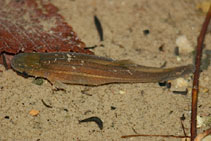
Rayons mous dorsaux (Total) : 9 - 11; Rayons mous anaux: 9 - 11; Vertèbres: 33 - 35. Scales minute and embedded. Pelvic fins absent. Branched caudal fin rays 11-17; branchiostegal rays 6. Triads of sensory papillae occur midlaterally and scattered clusters of neuromasts are present on the head. Coloration uniform dark gray to back with paler venter.
Body shape (shape guide): elongated.
Adults occur in springs and caves (but almost always near surface). They live underground but emerge above ground in springs (Ref. 5723). Active in springs at night and usually retreat underground during the day. The few individuals which venture into the spring portions of their habitat may show strong rheotaxis for half to one-minute periods but usually show strong thigmotaxis and hide under rocks or debris (Ref. 34868). Feed at night on amphipods, midge larvae, tiny worms and micro-crustaceans. Fecundity averages about 100 eggs per female (Ref. 10294). Eggs are carried in gill chambers of females (Ref. 205).
Cycle de vie et comportement reproducteur
Maturité | Reproduction | Frai | Œufs | Fécondité | Larves
Incubates eggs in gill chamber of females (Ref. 205).
Etnier, D.A. and W.C. Starnes, 1993. The fishes of Tennessee. The University of Tennessee Press, Knoxville, Tennessee, USA. (pls. check date). (Ref. 10294)
Statut dans la liste rouge de l'IUCN (Ref. 130435: Version 2025-2 (Global))
Menace pour l'homme
Harmless
Utilisations par l'homme
Outils
Articles particuliers
Télécharger en XML
Sources Internet
Estimations basées sur des modèles
Indice de diversité phylogénétique (Réf.
82804): PD
50 = 1.0081 [Uniqueness, from 0.5 = low to 2.0 = high].
Bayesian length-weight: a=0.00389 (0.00180 - 0.00842), b=3.12 (2.94 - 3.30), in cm total length, based on all LWR estimates for this body shape (Ref.
93245).
Niveau trophique (Réf.
69278): 3.3 ±0.44 se; based on food items.
Generation time: 1.6 ( na - na) years. Estimated as median ln(3)/K based on 1
growth studies.
Résilience (Réf.
120179): Haut, temps minimum de doublement de population inférieur à 15 mois (K=0.67; tm=1; tmax=3; Fec = 100).
Vulnérabilité de la pêche (Ref.
59153): Low vulnerability (21 of 100).
🛈