Taxonomic Remarks
This species is often confused with Nezumia aequalis (Günther, 1878).
Milieu: milieu / Klimaatzone / Diepte / verspreidingsgebied
Ecologie
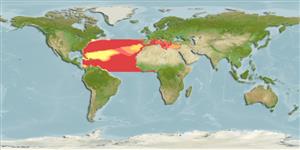
marien bathypelagisch; standvastig; diepte 130 - 3200 m (Ref. 3587), usually 450 - 730 m (Ref. 1371). Deep-water; 43°N - 4°N, 81°W - 36°E
Atlantic Ocean: North Atlantic south to the northern part of the Gulf of Guinea in the east, into the Mediterranean Sea, and north of Straits of Florida in the west.
Lengte bij maturiteit / Grootte / Gewicht / Leeftijd
Maturiteit: Lm 15.0, range 13 - 17 cm
Max length : 36.0 cm TL mannelijk / geslacht onbekend; (Ref. 3587)
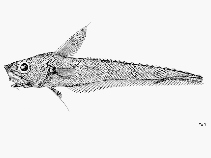
Dorsale stekels (totaal) : 2; Anale stekels: 0. Snout short, bluntly acute; terminal scute broad, blunt; ventral surface of snout without scales posteriorly including most of suborbital, mandible mostly naked, pores prominent on head. Pyloric caeca 22 to 29. Body scales with slender, conical, slanting spinules arranged in converging rows. Color in alcohol brownish, paler on head, with violet tinge on abdomen, some silvery reflections; fins pale to blackish; first dorsal fin uniformly blackish; mouth and gill cavity mostly black.
Body shape (shape guide): elongated; Cross section: oval.
Most numerous at 450 to 730 m in the open Atlantic and at 500 to 800 m in the Mediterranean. Feeds on small crustaceans (copepods, amphipods, decapods, mysids, etc.) and polychaetes (Ref. 1371)
Levenscyclus en paargedrag
Maturiteit | Voortplanting | Paaien | Eieren | Fecunditeit | Larven
Cohen, D.M., T. Inada, T. Iwamoto and N. Scialabba, 1990. FAO species catalogue. Vol. 10. Gadiform fishes of the world (Order Gadiformes). An annotated and illustrated catalogue of cods, hakes, grenadiers and other gadiform fishes known to date. FAO Fish. Synop. 125(10). Rome: FAO. 442 p. (Ref. 1371)
Status op de Rode Lijst van het IUCN (Ref. 130435: Version 2025-2 (Global))
Gevaar voor de mens
Harmless
Gebruik door de mens
Visserij: van minder commercieel belang
Tools
Speciale rapporten
Download XML
Internetbronnen
Schattingen op basis van modellen
Gewenste temperatuur (Ref.
123201): 6.3 - 14, mean 12.3 °C (based on 169 cells).
Fylogenetische diversiteitsindex (Ref.
82804): PD
50 = 0.5000 [Uniqueness, from 0.5 = low to 2.0 = high].
Bayesian length-weight: a=0.00129 (0.00076 - 0.00218), b=3.13 (2.98 - 3.28), in cm total length, based on LWR estimates for this species & (Sub)family-body (Ref.
93245).
Trofisch niveau (Ref.
69278): 3.2 ±0.34 se; based on food items.
Generation time: 6.9 ( na - na) years. Estimated as median ln(3)/K based on 1
growth studies.
Weerstandsvermogen (Ref.
120179): Gemiddeld, minimale populatieverdubbelingstijd 1,4-4,4 jaar (K=0.10-0.16; tmax=9).
Kwetsbaarheid van de visserij (Ref.
59153): Moderate to high vulnerability (48 of 100).
🛈
Voedingsstoffen (Ref.
124155): Calcium = 28.8 [7.6, 70.7] mg/100g; Iron = 0.294 [0.121, 0.874] mg/100g; Protein = 16.9 [15.0, 18.7] %; Omega3 = 0.119 [0.042, 0.315] g/100g; Selenium = 22.1 [6.4, 62.2] μg/100g; VitaminA = 31.3 [3.4, 282.7] μg/100g; Zinc = 0.713 [0.371, 1.463] mg/100g (wet weight);