>
Gadiformes (Cods) >
Macrouridae (Grenadiers or rattails)
Etymology: Nezumia: A Japanese word that means "mouse"; stelgidolepis: stelgidolepis meaning scraper scale, referring to the rasplike scales that cover the body (Ref. 4525).
More on author: Gilbert.
Environnement : milieu / zone climatique / profondeur / gamme de distribution
Écologie
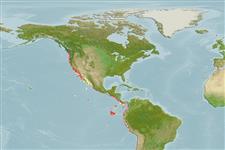
marin bathydémersal; non migrateur; profondeur 277 - 909 m (Ref. 1371). Deep-water; 49°N - 16°S, 130°W - 76°W (Ref. 1371)
Eastern Pacific: off Vancouver Island, Canada to southern Peru.
Taille / Poids / Âge
Maturité: Lm ? range ? - ? cm
Max length : 84.0 cm TL (female)
Description synthétique
Clés d'identification | Morphologie | Morphométrie
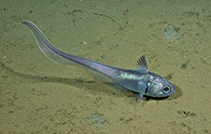
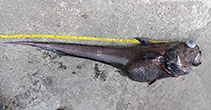
Épines dorsales (Total) : 2; Épines anales: 0. Snout short, narrow, bluntly pointed; terminal snout scute developed but not conspicuously; suborbital ridge low; underside of snout, most of the suborbital region, and anterior half of mandible without scales; cephalic pores of the lateralis system prominent. Pyloric caeca 24 to 58. Body scales densely covered with conical to narrowly lanceolate spinules in short, slightly convergent rows. Overall color is swarthy, blackish ventrally, with bluish tinge on abdominal region; oral and branchial cavities generally pale with some blackish areas; fins dusky to blackish, first dorsal fin slightly paler basally.
Body shape (shape guide): elongated; Cross section: oval.
Food items are generally forcibly regurgitated by the fish's expunging gas bladder as it is hauled from the depths, but fish remains have been caught inside the mouth of a few individuals. Considered opportunistic feeders and will eat whatever animal food they encounter in the natural habitat as long as it is of appropriate size (Ref. 4525).
Cycle de vie et comportement reproducteur
Maturité | Reproduction | Frai | Œufs | Fécondité | Larves
Cohen, D.M., T. Inada, T. Iwamoto and N. Scialabba, 1990. FAO species catalogue. Vol. 10. Gadiform fishes of the world (Order Gadiformes). An annotated and illustrated catalogue of cods, hakes, grenadiers and other gadiform fishes known to date. FAO Fish. Synop. 125(10). Rome: FAO. 442 p. (Ref. 1371)
Statut dans la liste rouge de l'IUCN (Ref. 130435: Version 2025-2 (Global))
Menace pour l'homme
Harmless
Utilisations par l'homme
Pêcheries: intérêt commercial mineur
Outils
Articles particuliers
Télécharger en XML
Sources Internet
Estimations basées sur des modèles
Température préférée (Réf.
123201): 5 - 9.8, mean 8.4 °C (based on 47 cells).
Indice de diversité phylogénétique (Réf.
82804): PD
50 = 0.5000 [Uniqueness, from 0.5 = low to 2.0 = high].
Bayesian length-weight: a=0.00214 (0.00123 - 0.00371), b=3.18 (3.02 - 3.34), in cm total length, based on LWR estimates for this species & (Sub)family-body (Ref.
93245).
Niveau trophique (Réf.
69278): 4.4 ±0.80 se; based on food items.
Generation time: 5.5 ( na - na) years. Estimated as median ln(3)/K based on 1
growth studies.
Résilience (Réf.
120179): Milieu, temps minimum de doublement de population : 1,4 à 4,4 années (K=0.20).
Vulnérabilité de la pêche (Ref.
59153): Moderate to high vulnerability (51 of 100).
🛈